Part of our guideANPR & LPR Cameras →
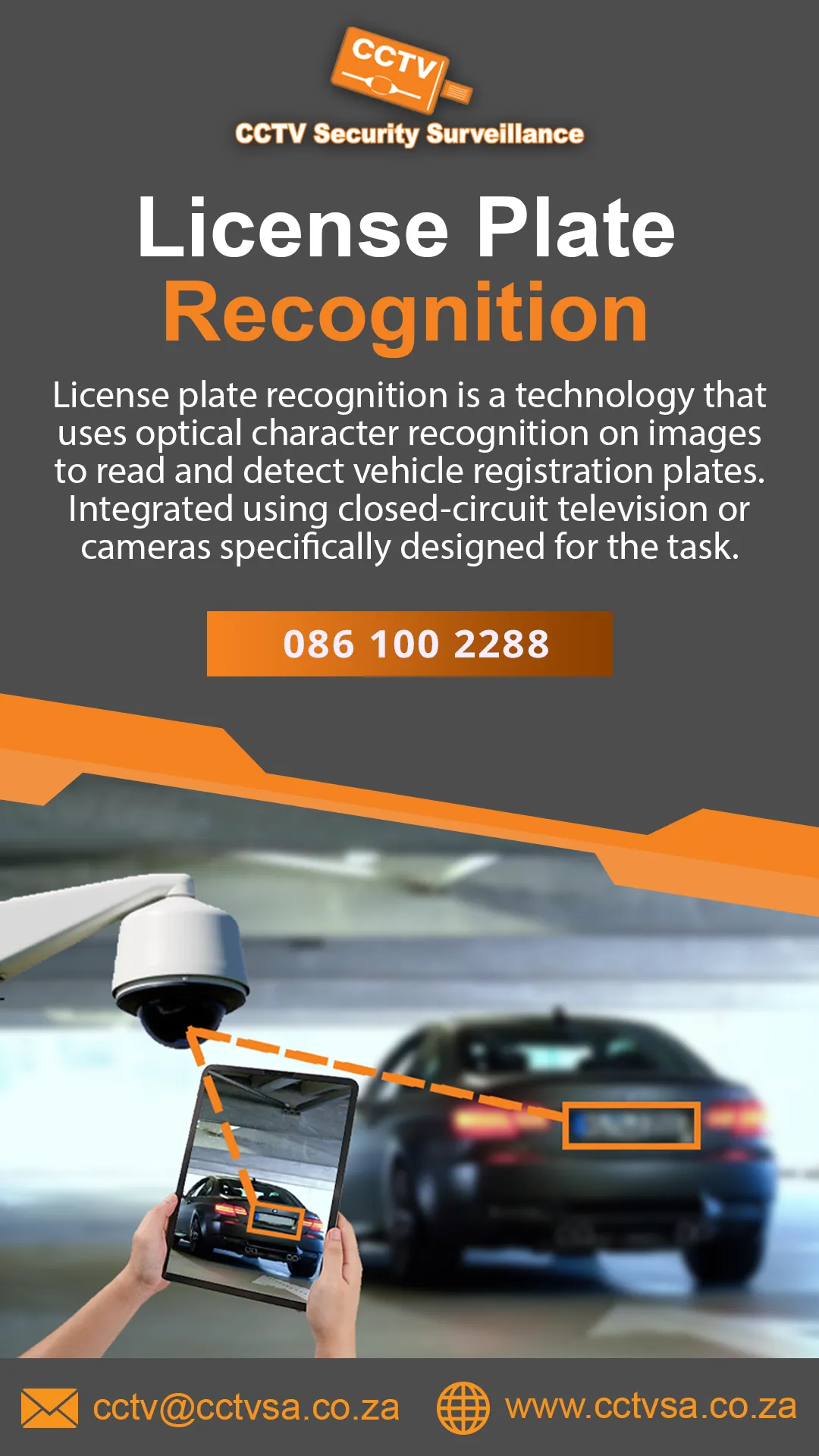
Licence plate recognition (LPR), also called automatic number plate recognition (ANPR), works in five steps: a camera captures the vehicle, software finds the plate in the image, splits it into characters, reads them with optical character recognition (OCR), and stores the result with the time and location. Accuracy depends mostly on camera position, lighting, plate condition and vehicle speed.
This guide explains the technology. For what LPR can do for your business, see LPR and ANPR cameras and our ANPR cameras service.
Key takeaways
- LPR works in five steps: capture, pre-process, split characters, read them with OCR, then store and match.
- Accuracy depends on camera angle, distance, speed, lighting and plate condition.
- Plate data linked to people is personal information under POPIA, so plan purpose and retention.
Want a system designed around your site?
We design every system around your premises, risks and operations, starting with a free on-site assessment.
Request a Free Site AssessmentCall 0861 002 288How does licence plate recognition work?
| Step | What happens |
|---|---|
| 1. Image capture | A camera at a gate, road or car park captures the vehicle and plate |
| 2. Pre-processing | The image is enhanced and cleaned up, and the plate area is isolated |
| 3. Character segmentation | The plate is split into individual characters |
| 4. OCR | Each character is recognised from its shape, size and pattern |
| 5. Storage and matching | The plate, time and location are stored and checked against lists |
What makes ANPR "automatic"?
ANPR systems do all of this in real time, without anyone pressing a button. They use high-resolution cameras designed to capture moving vehicles, dedicated processing hardware or software to read plates on the fly, and a link to a database so each plate can be checked immediately against allowed lists or watchlists.
Where is LPR used?
- Security and access control: opening gates for approved vehicles and flagging unwanted ones. See access control.
- Parking management: automatic entry and exit, and tracking how long vehicles stay. See parking guidance.
- Traffic monitoring: counting vehicles and analysing congestion.
- Weighbridges and logistics: linking plates to loads. See weighbridge integration.
- Toll collection: charging vehicles automatically by plate.
What affects LPR accuracy?
| Factor | How to manage it |
|---|---|
| Camera angle and height | Mount for a clear, straight-on view of the plate |
| Distance and zoom | Size the image so the plate has enough pixels |
| Vehicle speed | Use cameras and settings designed for moving vehicles; slow traffic at the read point |
| Lighting and glare | Use infrared illumination for night reads and avoid headlight glare |
| Dirty or damaged plates | Expect some misreads; add make, model and colour recognition |
| Weather | Plan for rain and dust; keep lenses clean through maintenance |
Regular maintenance and software updates keep accuracy high over time.
What are the challenges to plan for?
Privacy and POPIA
Plate data linked to people is personal information. Set a clear purpose, decide how long data is kept, restrict who can search it and protect it from unauthorised access. See the Information Regulator.
Cost and infrastructure
Dedicated LPR cameras, processing and integration with gates cost more than general CCTV. Assess the benefit for each entrance, such as fewer guards needed or faster entry, against the cost.
What does the research say?
The same meta-analysis found about 16% lower odds of property crime and of vehicle crime, the offences where cameras have the clearest effect. (Piza et al. (2019), 40-year CCTV meta-analysis, via CrimeSolutions)
Car parks showed the largest effect of any setting studied: CCTV schemes there were associated with a 37% reduction in crime. (Piza et al. (2019), 40-year CCTV meta-analysis, via CrimeSolutions)
In July 2023 the Information Regulator issued its first POPIA administrative fine, R5 million, to the Department of Justice after a cyberattack, finding it had let security safeguards such as antivirus and intrusion detection licences lapse. (SAnews (2023))
From our projects: Automotive parts warehouse - perimeter AI & LPR
Johannesburg East Rand, completed December 2025. High-theft automotive parts warehouse with perimeter AI detection, LPR vehicle control, internal access control and 24/7 monitoring.
Cameras: 35 × 4MP + LPR + thermal · Perimeter: AI-protected
The Bottom Line
LPR turns a camera image into plate data in five steps, and good accuracy comes down to camera placement, lighting and maintenance. Planned with privacy and cost in mind, it is a reliable way to automate and secure vehicle access.
CCTV Security Surveillance has designed and installed security systems since 1967. To plan LPR for your site, request a quote or call 0861 002 288. You can also contact your nearest branch in Gauteng, KwaZulu-Natal, the Western Cape or the Eastern Cape.
Ready to put this to work on your site?
Book a free site assessment. We'll look at your premises, recommend the right system for each area and show you where it will make the biggest difference, with no obligation.
Request a Free Site AssessmentSpeak to a Security Specialist