Part of our guideCCTV Systems →
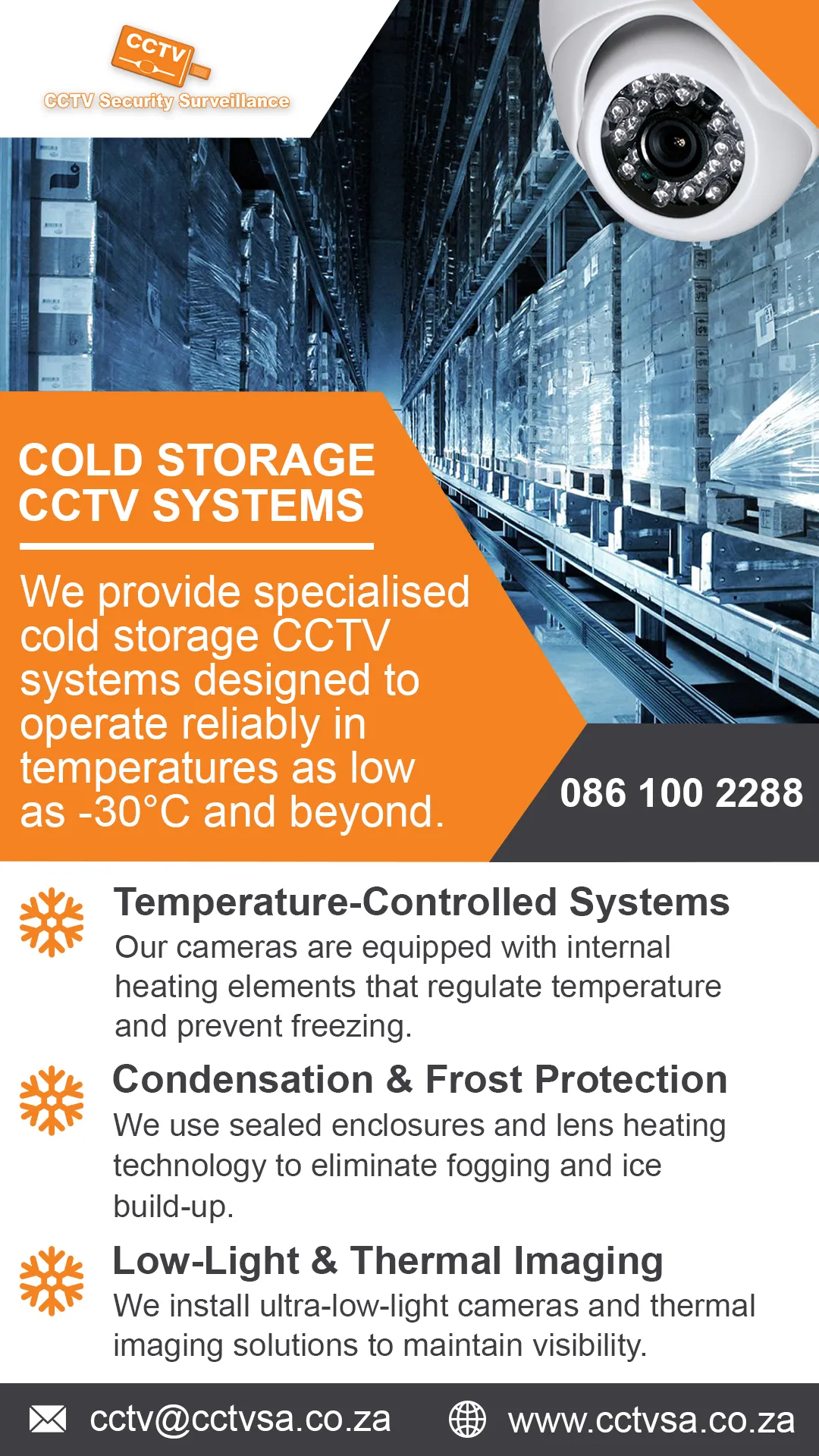
Cold storage CCTV uses cameras built for sub-zero conditions: heated, sealed housings that stop frost and condensation, lens heating to prevent fogging, cold-start capability after power cuts, and low-light or thermal cameras for dim freezer aisles. CCTV Security Surveillance installs freezer systems rated to operate down to -30°C, depending on the model and facility.
Standard cameras aren't designed for freezers, which is why cold rooms need a specialised CCTV system rather than an off-the-shelf installation.
Key takeaways
- Ordinary cameras fail in freezers from condensation, frost and cold restarts.
- Freezer-ready cameras use heated, sealed housings and lens heating, rated to around -30°C depending on model.
- Extreme cold speeds up wear, so seals, heaters and mounts need regular maintenance.
Want a system designed around your site?
We design every system around your premises, risks and operations, starting with a free on-site assessment.
Request a Free Site AssessmentCall 0861 002 288Why do cold storage facilities need specialised CCTV?
Freezers and cold rooms are high-risk areas: visibility is limited, temperatures are extreme, and goods move constantly. Incidents are easy to miss. A properly designed freezer CCTV system helps you:
- monitor stock handling and reduce shrinkage;
- support health and safety compliance;
- protect staff working in hazardous conditions;
- track operational efficiency;
- provide video evidence for audits, insurance claims and disputes.
What goes wrong with normal cameras in a freezer?
| Problem | What it causes |
|---|---|
| Condensation and frost | Damage to internal electronics |
| Lens fogging | Blurred or blocked images |
| Thermal contraction | Stress on housings and mounts |
| Power interruptions | Cameras that fail to restart in the cold |
| Low light | Poor image quality in dim aisles |
How does freezer-ready CCTV solve these problems?
Heated cameras and housings
Internal heating elements keep the camera at a working temperature, so it performs consistently in sub-zero rooms.
Anti-condensation and frost protection
Sealed enclosures and lens heating prevent fogging and ice build-up, keeping footage clear.
Cold-start functionality
After a power cut, ordinary cameras often fail to restart in the cold. Freezer-ready cameras are designed to warm up, restart and stabilise safely.
Low-light and thermal imaging
Freezers are usually dimly lit. Low-light cameras and thermal imaging maintain visibility without adding lighting and energy costs.
Durable industrial enclosures
Corrosion-resistant, temperature-stable enclosures withstand constant freezing conditions.
Which facilities use cold storage CCTV?
- Food storage and distribution centres. See CCTV for logistics and warehousing.
- Meat processing facilities.
- Pharmaceutical cold chain sites.
- Supermarket and retail cold rooms.
- Logistics and warehousing operations with chilled or frozen stock.
Why is maintenance critical in freezers?
Extreme cold speeds up wear, and a failed camera in a freezer often goes unnoticed until an incident. Our maintenance agreements for cold storage include:
- seal and gasket inspections to keep moisture out;
- lens heater checks to prevent ice build-up;
- mount and bracket inspections;
- health checks on recorders and storage;
- firmware updates.
What should you check when planning freezer CCTV?
- Temperature rating: confirm every camera and housing is rated below your coldest room.
- Transitions: doors between ambient and freezer areas cause condensation; plan camera positions with this in mind.
- Power backup: keep cameras running and avoid cold restarts during load-shedding.
- Lighting: decide between low-light and thermal cameras for each area.
- Access to footage: cold storage systems can be linked to cloud recording for remote viewing.
What does the research say?
The ACFE's 2026 study of 2,402 occupational fraud cases found the median scheme ran 12 months before detection, and proactive data monitoring was associated with lower losses and faster detection. (ACFE (2026), Occupational Fraud 2026: A Report to the Nations)
The same meta-analysis found about 16% lower odds of property crime and of vehicle crime, the offences where cameras have the clearest effect. (Piza et al. (2019), 40-year CCTV meta-analysis, via CrimeSolutions)
South Africa had load-shedding on 287 days of 2023 by mid-December, a total of 6,894 hours, against 157 days in 2022, according to EskomSePush data. (Daily News (2023), citing EskomSePush)
From our projects: Cold storage facility - temperature-linked monitoring
Durban, KZN, completed October 2025. Cold storage facility with CCTV linked to temperature sensors, access control, PPE detection and 24/7 monitoring.
Cameras: 28 × 4MP IP · Cold rooms: 8 monitored
The Bottom Line
Freezers defeat ordinary cameras. Cold storage CCTV, with heated and sealed housings, cold-start capability and low-light imaging, keeps your stock, staff and compliance visible in sub-zero conditions, as long as it is properly maintained.
To plan CCTV for your cold storage facility, request a quote or call 0861 002 288. You can also contact your nearest branch in Gauteng, KwaZulu-Natal, the Western Cape or the Eastern Cape.
Ready to put this to work on your site?
Book a free site assessment. We'll look at your premises, recommend the right system for each area and show you where it will make the biggest difference, with no obligation.
Request a Free Site AssessmentSpeak to a Security Specialist