Part of our guideIntegrated Security →
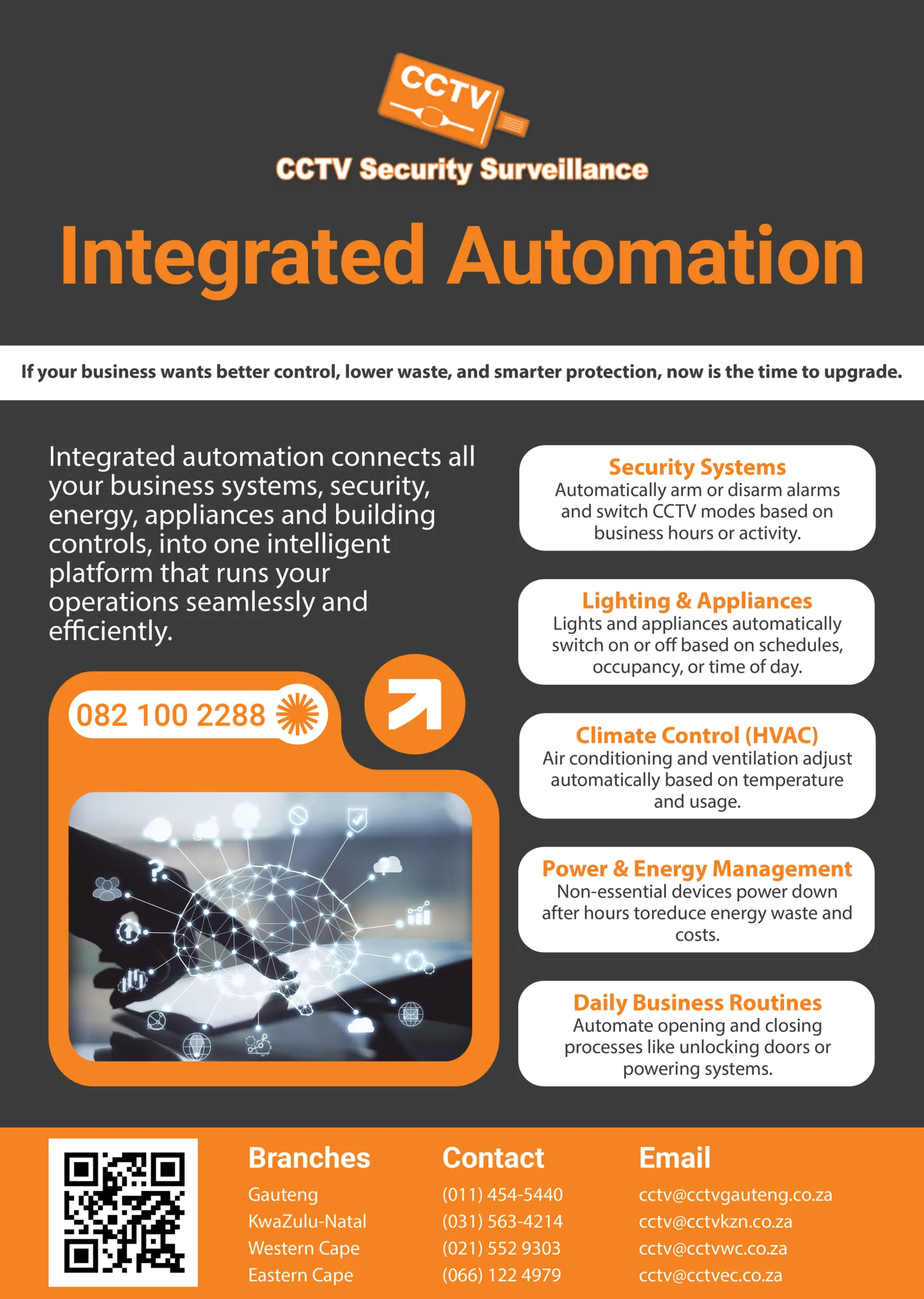
Integrated automation and security connects CCTV, access control, alarms, lighting, climate control and building sensors on one platform, so they work together through rules and schedules. The first authorised entry of the day can switch on lights and air conditioning, after-hours motion can trigger floodlights and send a camera feed to your phone, and leaks or overheating can be caught before they cause damage.
We design these systems for businesses across Gauteng, KwaZulu-Natal, the Western Cape and the Eastern Cape, built around our CCTV systems and access control. They form part of our integrated security solutions.
Key takeaways
- One platform links CCTV, access control, alarms, lighting, climate control and building sensors.
- After-hours motion can switch on floodlights and push the nearest camera feed to a manager's phone.
- Automated lighting, shutdowns and sensor-based air conditioning cut electricity waste.
Want a system designed around your site?
We design every system around your premises, risks and operations, starting with a free on-site assessment.
Request a Free Site AssessmentCall 0861 002 288What is integrated security automation?
It replaces separate systems, each with its own controls, with one platform where events in one system trigger actions in another. For example, when the first authorised employee arrives:
- lights switch on;
- air conditioning starts;
- perimeter night mode switches off in approved zones;
- internal cameras switch to day settings;
- doors unlock only for approved users.
How does automation make CCTV more effective?
| Event | Automated response |
|---|---|
| Motion in a restricted area after hours | Floodlights switch on, often deterring intruders before damage is done |
| Alarm, smoke sensor or leak sensor triggers | The nearest camera feed appears on a manager's phone for instant verification |
| Verified incident | The response follows a set procedure instead of guesswork |
Linked to our offsite monitoring control room, alerts are verified by trained operators around the clock.
How can automation cut electricity costs?
- Automated lighting: occupancy sensors and schedules switch off lights in empty rooms and low-use zones.
- Smart shutdown: printers, monitors, coffee machines and other non-essential devices power down after hours.
- Efficient climate control: temperature sensors run air conditioning only when needed, rather than on fixed timers.
How does automation prevent damage?
Not every loss is a crime. Sensors can catch problems early:
- Water leaks: moisture sensors can trigger an automatic shut-off valve when a pipe bursts.
- Air quality: high CO2 levels can trigger ventilation automatically.
- Critical rooms: server rooms, storage and control rooms can be monitored for heat and humidity. For machinery, see thermal cameras for equipment temperature.
Which businesses benefit most?
- Warehousing and logistics: gates, loading zones, lighting and stock protection.
- Retail and shopping centres: access, energy use and instant incident verification.
- Offices and corporate buildings: entry, climate control, meeting room access and after-hours security.
- Manufacturing and industrial sites: high-risk zones, equipment areas and perimeter response. See integrated CCTV for manufacturing.
- Healthcare and education: secure access points and safe environments.
Can multiple sites be managed remotely?
Yes. From one secure dashboard, authorised users can view cameras, control doors and gates, change schedules, check alarm status, monitor energy use and receive alerts from every branch.
Why does professional installation matter?
Poorly connected systems cause delays, false alerts and frustration. A good integration needs:
- secure, encrypted networks. See network security for surveillance;
- reliable communication between devices;
- user-friendly controls;
- room to grow;
- ongoing support and maintenance.
For how connected devices work together, see IoT in security systems.
What does the research say?
CCTV combined with other measures such as access control, lighting or guarding produced larger effects than cameras alone, and the researchers advise against using CCTV as a stand-alone measure. (Piza et al. (2019), Criminology & Public Policy)
Insurer guidance on thermographic surveys notes that about 40% of industry's fire loss expenses and roughly 20% of major fires are caused by electrical faults, and recommends infrared surveys as a fast, cost-effective preventive maintenance tool. (If P&C Insurance, Thermographic Surveys)
South Africa had load-shedding on 287 days of 2023 by mid-December, a total of 6,894 hours, against 157 days in 2022, according to EskomSePush data. (Daily News (2023), citing EskomSePush)
From our projects: Corporate tower - enterprise security & compliance
Johannesburg CBD, completed January 2026. 32-storey corporate tower with enterprise-grade CCTV, lift monitoring, data centre security and 24/7 offsite protection.
Cameras: 384 × 4MP IP · Stories: 32 · Tenants: 48
The Bottom Line
Integrated automation makes your building secure, efficient and easier to run: systems that react to each other, lights and climate that follow occupancy, and early warning of leaks and faults, all from one platform.
To plan integrated automation for your business, request a quote or call 0861 002 288. You can also contact your nearest branch in Gauteng, KwaZulu-Natal, the Western Cape or the Eastern Cape.
Ready to put this to work on your site?
Book a free site assessment. We'll look at your premises, recommend the right system for each area and show you where it will make the biggest difference, with no obligation.
Request a Free Site AssessmentSpeak to a Security Specialist