Part of our guideVideo Analytics →
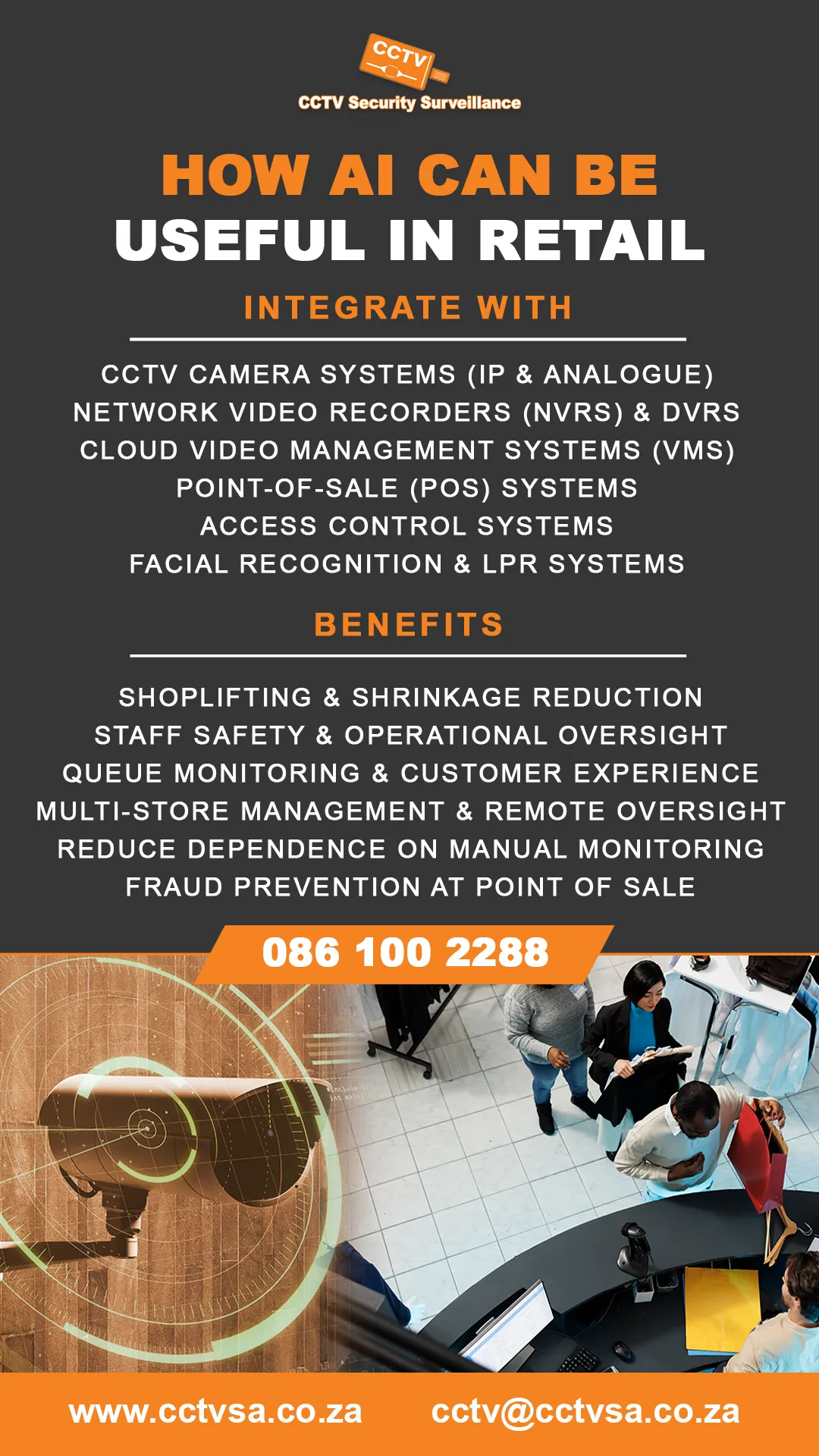
AI is useful in retail because it analyses CCTV footage in real time and alerts staff to what matters: likely shoplifting, aggressive behaviour, long queues and suspicious till transactions. That moves store security from reviewing footage after a loss to preventing incidents, and gives managers data on queues, dwell time and branch performance.
At CCTV Security Surveillance we implement AI video analytics for retailers across Gauteng, KwaZulu-Natal, the Western Cape and the Eastern Cape.
Key takeaways
- AI CCTV helps stop shoplifting early, protect staff, shorten queues and catch till fraud.
- Monitoring POS transactions cut theft by 22% in a study of 392 restaurants.
- Multi-store retailers get alerts, cloud storage and reports from every branch in one place.
Want a system designed around your site?
We design every system around your premises, risks and operations, starting with a free on-site assessment.
Request a Free Site AssessmentCall 0861 002 288What does AI in retail actually mean?
In physical stores, AI means computer vision and machine learning that analyse live CCTV footage. Instead of people watching dozens of screens, AI watches every camera, recognises risk patterns and sends alerts the moment something suspicious happens.
How does AI reduce shoplifting and shrinkage?
AI is trained to spot behaviour such as concealing items in bags or clothing, staging high-value items in blind spots, unusual loitering in high-risk aisles and suspicious group behaviour. It sends the store manager or guard an alert with a short clip and the location, so staff can step in early, often just by engaging the customer, instead of confronting someone at the exit. See AI shoplift detection and how it works.
How does AI protect staff?
Stores can become volatile, especially at peak times, festive season and during promotions. AI CCTV can detect:
- aggressive behaviour or physical altercations;
- loitering near cash points;
- unusual activity after closing time;
- staff asleep or neglecting duties on security posts.
That lets managers act before situations escalate.
How does AI improve queues and customer experience?
AI-enabled cameras can measure:
- queue length at tills;
- customer dwell time;
- congestion points in the store;
- peak shopping hours.
Managers can adjust staffing in real time to cut waiting times. See till queue systems and heat mapping.
How does AI help prevent till fraud?
Retail fraud includes sweethearting (staff giving goods to friends), refund fraud, void abuse and transaction manipulation. AI linked to point-of-sale systems can flag suspicious transactions and link them to the matching video, for example a refund processed outside standard procedure. See POS and scale integration.
How does AI help multi-store retailers?
| Need | How AI CCTV helps |
|---|---|
| Know what's happening at every branch | Real-time alerts from all stores in one place |
| Keep evidence safe | Cloud video storage |
| Compare branches | Automated reports on incidents, queues and traffic |
| Keep systems working | Health monitoring of cameras and recorders |
Does AI replace security guards?
No. AI watches every camera at once, highlights only relevant events and reduces false alarms, but people still respond. It makes guards and floor staff more effective, letting them stay active on the floor.
What should retailers check before adding AI?
- Existing cameras: many AI solutions work with existing IP cameras.
- Configuration: poorly set-up analytics create false alerts; rules must suit each store.
- Who responds: alerts must reach someone who can act quickly.
- POPIA: AI CCTV analyses behaviour, but footage of identifiable people is still personal information. Use signage, define retention and limit access. See the Information Regulator.
What does the research say?
The US National Retail Federation found average retail shrink rose to 1.6% in fiscal 2022, about US$112.1 billion in losses, with internal and external theft causing about 65% of it. (NRF (2023), National Retail Security Survey)
A study of 392 restaurants found that after they adopted software that monitors point-of-sale transactions, theft fell by 22% and average weekly revenue rose by about 7%, mainly because staff behaviour changed. (Pierce, Snow & McAfee (2015), Management Science)
A randomised controlled trial across 47 retail stores found positive evidence that visible in-aisle cameras and public-view monitors reduce opportunities for theft in real store conditions. (Hayes & Downs (2011), Security Journal)
From our projects: Supermarket network - multi-store shrinkage control
Johannesburg metro, completed January 2026. Enterprise CCTV across 8 supermarket stores - 148 cameras, a centralised head-office dashboard, AI analytics and 24/7 monitoring.
Stores: 8 locations · Cameras: 148 × 4MP IP · Cost per store: R45k/month
The Bottom Line
AI makes retail CCTV work harder: it helps stop theft early, protects staff, shortens queues, catches till fraud and gives head office a view of every branch. Set up correctly, it pays for itself through lower losses and better operations.
To plan AI CCTV for your stores, request a quote or call 0861 002 288. You can also contact your nearest branch in Gauteng, KwaZulu-Natal, the Western Cape or the Eastern Cape.
Ready to put this to work on your site?
Book a free site assessment. We'll look at your premises, recommend the right system for each area and show you where it will make the biggest difference, with no obligation.
Request a Free Site AssessmentSpeak to a Security Specialist