Part of our guideVideo Analytics →
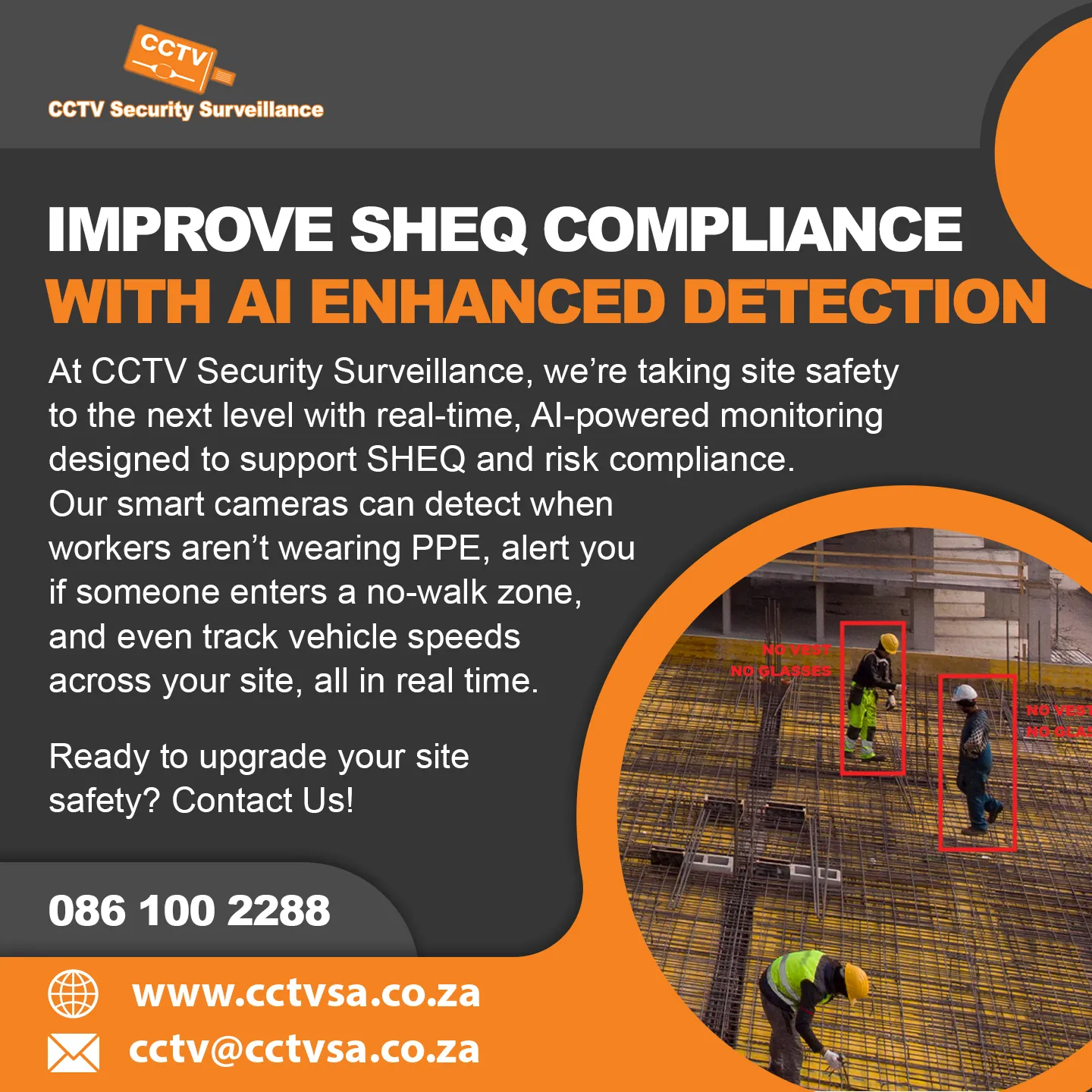
AI surveillance supports SHEQ (safety, health, environment and quality) compliance by watching site cameras in real time for three common risks: people without the required PPE, people entering restricted or no-walk zones, and vehicles exceeding site speed limits. Each event triggers an alert to SHEQ or control room staff and is logged with timestamped footage for reports and audits.
It is one of the safety applications of our AI video analytics, used on construction sites, mines, factories and logistics hubs.
Key takeaways
- AI flags missing PPE, people in no-walk zones and speeding vehicles in real time.
- Every incident is logged with timestamped footage for SHEQ reports and audits.
- Observe-and-feedback safety methods cut incident rates in a meta-analysis of 73 programmes.
Want a system designed around your site?
We design every system around your premises, risks and operations, starting with a free on-site assessment.
Request a Free Site AssessmentCall 0861 002 288Why use AI for SHEQ compliance?
Supervisors can't walk every part of a busy site all the time, and checking footage after an accident is too late. AI watches every camera continuously and tells safety staff the moment something isn't right, so they can intervene before someone is hurt.
What can AI detect on site?
Missing PPE
AI is trained to recognise common PPE, including:
- hard hats;
- high-visibility vests;
- safety goggles;
- ear protection.
It flags anyone without the required PPE in a designated zone and alerts SHEQ or control room staff. For sites that run Milestone XProtect, see AI PPE detection for XProtect.
People in restricted and no-walk zones
Using virtual boundaries and object recognition, the system tells workers apart from vehicles and machinery. If a person enters an area where only machinery should operate, it raises an alert with visual evidence and logs the time.
Vehicle speed
Within geofenced zones, the AI tracks vehicle movement and speed, logs violations of site speed limits and provides timestamped footage for review.
What does AI SHEQ monitoring look like in practice?
| Risk | What the AI does | What the SHEQ officer gets |
|---|---|---|
| Worker without a hard hat in a hard-hat zone | Detects missing PPE | Real-time alert and clip |
| Person walking into a forklift-only area | Detects a person crossing a virtual boundary | Alert with timestamped image |
| Truck speeding through the yard | Measures speed in a geofenced zone | Logged violation with footage |
| Repeated near-misses at a junction | Logs incidents over time | Evidence to redesign the route |
Who responds to the alerts?
Alerts go to your SHEQ or security staff on site. If you don't have the people to check every alert, our offsite monitoring control room operators can verify alerts with the AI and escalate incidents immediately.
What are the benefits for SHEQ and risk officers?
- Real-time awareness of violations without constant patrols;
- Automatic incident logs with video for reports and audits;
- Faster response and clear escalation;
- Fewer injuries and near-misses over time;
- Evidence of compliance with safety policies and legislation.
Which sites benefit most?
- Construction sites with changing zones and heavy vehicles;
- Mines and quarries. See CCTV for mining;
- Factories and plants. See integrated CCTV for manufacturing;
- Logistics hubs and warehouses. See CCTV for logistics.
What should you plan before installing SHEQ analytics?
- Zones and rules: which PPE and which restricted areas apply where.
- Camera coverage: clear views of walkways, machinery areas and vehicle routes.
- Speed limits: define zones and limits for each route.
- Response: who receives alerts and what they do.
- Workforce communication and POPIA: explain the system's safety purpose to staff, and secure the footage. See the Information Regulator.
What does the research say?
A meta-analysis of 73 behaviour-based safety programmes, which observe work and feed back on unsafe acts, found incident rates kept falling for five years after introduction. Video safety analytics apply the same observe-and-feedback principle. (Krause, Seymour & Sloat (1999), Safety Science)
A US National Institute of Justice guide found that after only 20 minutes of watching and evaluating monitor screens, the attention of most people falls well below acceptable levels, which is why alert-driven monitoring and operator supervision matter. (Green (1999), National Institute of Justice)
Actively monitored CCTV, where operators alert security or police while an incident unfolds, was associated with significant crime reductions; systems that only record showed no significant effect. (Piza et al. (2019), 40-year CCTV meta-analysis, via CrimeSolutions)
From our projects: Gold mine - SHEQ compliance & precious metal security
Johannesburg area, completed January 2026. Large-scale gold mine with SHEQ-focused surveillance across plant, processing and high-security areas - 84 cameras, PPE detection, thermal perimeter, LPR and 24/7 monitoring.
Cameras: 84 × 4MP + thermal · PPE monitoring: Automated alerts
The Bottom Line
AI surveillance gives SHEQ teams eyes on the whole site, flagging missing PPE, people in danger zones and speeding vehicles while there is still time to act, and logging every incident for audits.
To plan AI safety monitoring for your site, request a quote or call 0861 002 288. You can also contact your nearest branch in Gauteng, KwaZulu-Natal, the Western Cape or the Eastern Cape.
Ready to put this to work on your site?
Book a free site assessment. We'll look at your premises, recommend the right system for each area and show you where it will make the biggest difference, with no obligation.
Request a Free Site AssessmentSpeak to a Security Specialist