
Part of our guideCCTV Systems →
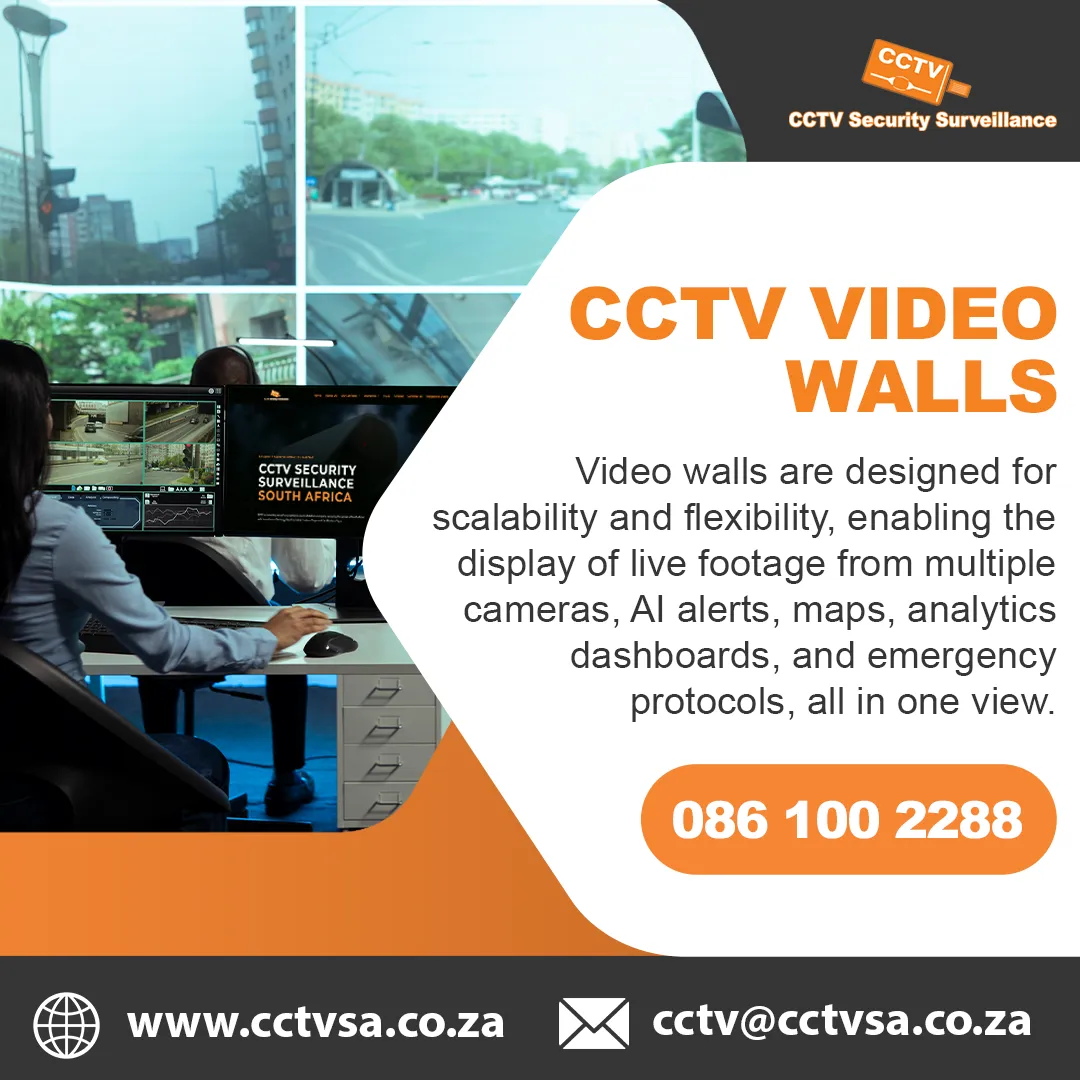
A CCTV video wall is a large display made of several high-resolution monitors working as one screen. It lets control room operators see many camera feeds, AI alerts, site maps and procedures at the same time, so they spot incidents sooner, coordinate better and respond faster across one site or many.
Video walls are a common part of larger CCTV systems, and they are central to how our own offsite monitoring control room works.
Key takeaways
- A video wall turns many monitors into one display for cameras, AI alerts, maps and procedures.
- Alert-driven layouts beat staring at feeds: attention to screens drops sharply after about 20 minutes.
- Shared views help teams coordinate with SAPS, fire services and keyholders during incidents.
Want a system designed around your site?
We design every system around your premises, risks and operations, starting with a free on-site assessment.
Request a Free Site AssessmentCall 0861 002 288What is a CCTV video wall?
A video wall combines multiple monitors into a single display. Unlike a single screen, it can be laid out flexibly: live cameras in one area, an alarm list in another, a site map showing where an alert came from, and a dashboard of analytics, all in one view. Video management software (VMS) controls what appears where.
What are the benefits of a video wall?
Better situational awareness
Seeing many feeds and sites at once gives operators an overview of everything happening, so threats and emergencies are noticed as they happen.
AI alerts brought to the front
Linked to AI video analytics, the wall can automatically bring an alert's camera forward, so the operator sees the right feed immediately. This supports black screen monitoring, where only relevant events are shown, rather than operators staring at dozens of idle feeds.
Easier teamwork during incidents
A large shared display helps operators, supervisors and responders work together, whether they are managing an internal incident or coordinating with SAPS, fire services or keyholders.
Central command and control
Bringing camera feeds, alarm data and controls into one place makes it easier to follow standard operating procedures and pass critical information on quickly, especially across multiple sites.
Video wall or standard monitors: what is the difference?
| Standard monitors | Video wall | |
|---|---|---|
| Number of feeds visible | A few per screen | Many, across one large display |
| Layout | Fixed per screen | Flexible areas for cameras, maps and alerts |
| Teamwork | Individual operator view | Shared view for the whole team |
| Best for | Small sites, single operators | Control rooms, multi-site monitoring |
Which sites benefit from a video wall?
- Residential estates and complexes: gate, perimeter and internal road cameras in one view. See CCTV for estates.
- Retail centres: many entrances, parking areas and stores.
- Industrial and logistics parks: yards, docks and perimeters.
- Corporate campuses: multiple buildings and access points.
- Public infrastructure and transport hubs: large, busy, high-risk spaces.
What should you plan when installing a video wall?
- What operators need to see: cameras, alarms, maps and dashboards, and how much space each needs.
- Video management software: a VMS that controls layouts and brings alerts forward.
- Operator comfort: viewing distance, screen brightness and seating for long shifts.
- Operator attention: larger control rooms benefit from operator monitoring to catch fatigue.
- Investigations: tools such as XProtect Rapid Review help teams review recorded footage together.
- Power and resilience: backup power so the control room keeps running in power cuts.
What does the research say?
A US National Institute of Justice guide found that after only 20 minutes of watching and evaluating monitor screens, the attention of most people falls well below acceptable levels, which is why alert-driven monitoring and operator supervision matter. (Green (1999), National Institute of Justice)
Actively monitored CCTV, where operators alert security or police while an incident unfolds, was associated with significant crime reductions; systems that only record showed no significant effect. (Piza et al. (2019), 40-year CCTV meta-analysis, via CrimeSolutions)
Car parks showed the largest effect of any setting studied: CCTV schemes there were associated with a 37% reduction in crime. (Piza et al. (2019), 40-year CCTV meta-analysis, via CrimeSolutions)
From our projects: Shopping mall - anchor tenants & common areas
Sandton, Johannesburg, completed March 2026. Integrated CCTV across shopping mall common areas, perimeter and 12 anchor tenant stores - 256 cameras, access control at 18 entry points, AI perimeter protection and 24/7 monitoring.
Cameras: 256 × 4MP + 8 × thermal · Entry points: 18 access-controlled · Anchor stores: 12 integrated
The Bottom Line
A video wall turns a control room into a single, shared view of everything that matters. With AI alerts and good video management software, it helps teams see incidents sooner and respond together.
To plan a video wall or control room, request a quote or call 0861 002 288. You can also contact your nearest branch in Gauteng, KwaZulu-Natal, the Western Cape or the Eastern Cape.
Ready to put this to work on your site?
Book a free site assessment. We'll look at your premises, recommend the right system for each area and show you where it will make the biggest difference, with no obligation.
Request a Free Site AssessmentSpeak to a Security Specialist