Part of our guideCCTV Systems →
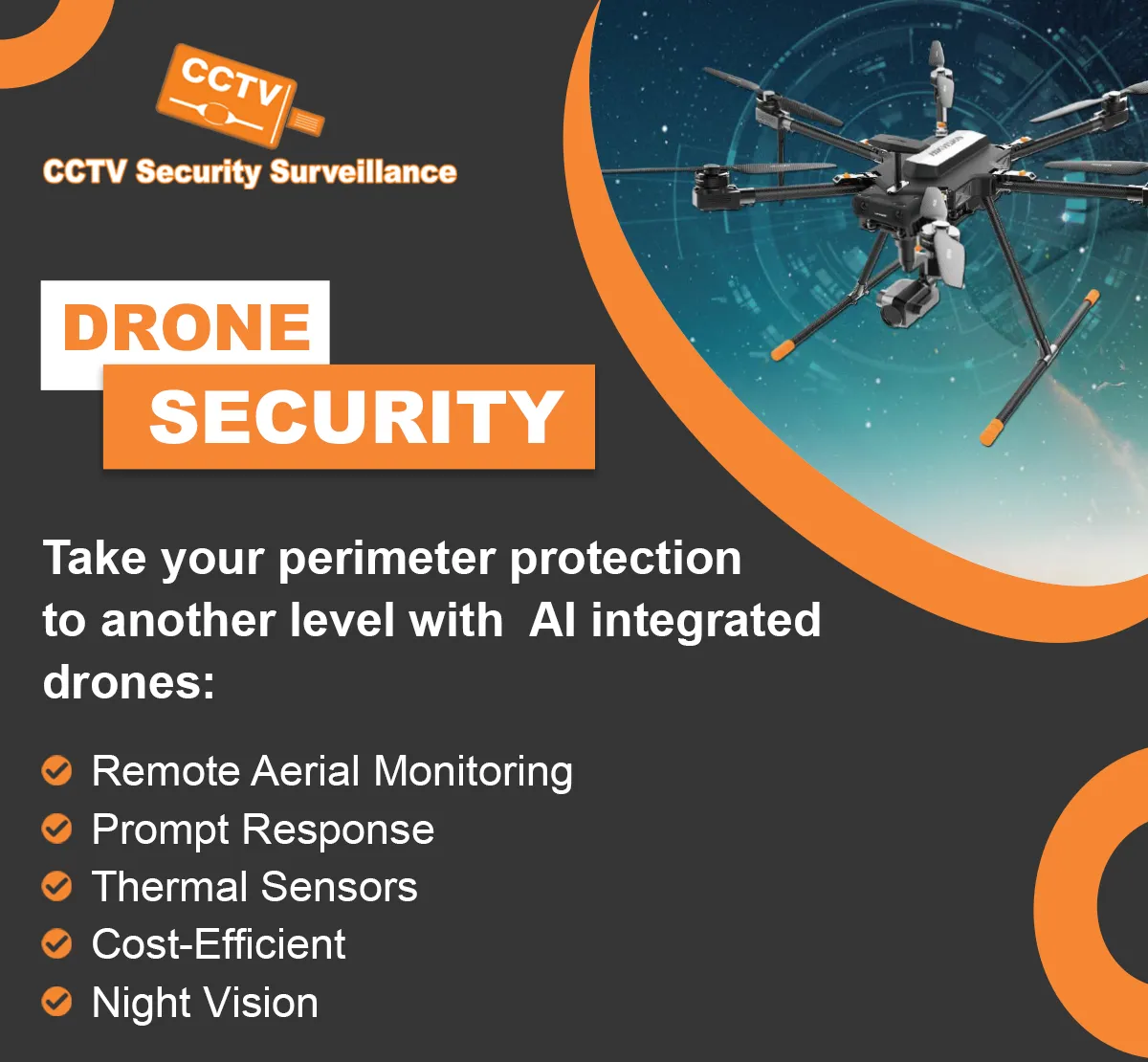
Security drones add a mobile, aerial camera to your security: they can reach large or hard-to-access areas quickly, fly to an alarm point and stream live video to the security team, follow a suspect, and, with thermal or infrared cameras, work in the dark. They fill the gaps that fixed CCTV cameras and guards on foot can't cover.
Drones complement, rather than replace, fixed CCTV systems and offsite monitoring.
Key takeaways
- Drones reach large or hard-to-access areas fast and stream live video to the security team.
- With thermal or infrared cameras, they can respond to alarms and track suspects at night.
- Commercial drone use is regulated by SACAA under Part 101, with licensed pilots and operator approval.
Want a system designed around your site?
We design every system around your premises, risks and operations, starting with a free on-site assessment.
Request a Free Site AssessmentCall 0861 002 288Why are businesses using drones for security?
Fixed cameras only see where they are pointed, which leaves blind spots on large sites, and guards can only be in one place at a time. Drones move to where they are needed, and have become far more affordable than older forms of aerial surveillance.
What are the benefits of security drones?
| Benefit | What it means on site |
|---|---|
| Fast response | Reaches an alarm point quickly and streams live video before guards arrive |
| Large-area coverage | Surveys big or hard-to-reach areas such as plants, yards and farms |
| Tracking | Can follow a suspect and give responders real-time location information |
| After-dark operations | Infrared and thermal cameras work in low or no light |
| Cost-effective aerial view | Far cheaper than traditional aerial surveillance |
| AI patrols | AI-equipped drones can be programmed for scheduled patrols |
How do drones work with other security systems?
- An alarm triggers, for example from an electric fence or AI camera.
- A drone is sent to the location and streams live video.
- The security team or control room assesses the threat before sending guards.
- If the intruder flees, the drone can follow and share their position.
For fixed, around-the-clock perimeter detection, thermal cameras with offsite monitoring remain the backbone; drones add a mobile layer.
Where are security drones most useful?
- Large industrial plants and factories with long perimeters.
- Warehouses and logistics yards with stacked containers and blind spots.
- Farms and agricultural land. See farm CCTV.
- Mines, solar plants and remote infrastructure.
- Construction sites that change as work progresses.
What rules apply to security drones in South Africa?
Drones used for commercial purposes, including security, are regulated by the South African Civil Aviation Authority (SACAA) under Part 101 of the Civil Aviation Regulations. Commercial operators generally need SACAA approval, and pilots need the appropriate licence. Check current requirements with the SACAA before flying. Privacy also matters: drone footage of identifiable people is personal information under POPIA.
What should you plan before using drones?
- Use case: routine patrols, alarm response or both?
- Regulation: who will operate the drone, and under which SACAA approvals?
- Cameras: day, infrared or thermal, depending on when and where it will fly.
- Integration: how drone video reaches guards and the control room.
- Weather and battery life: how they limit flight time and availability.
What does the research say?
Actively monitored CCTV, where operators alert security or police while an incident unfolds, was associated with significant crime reductions; systems that only record showed no significant effect. (Piza et al. (2019), 40-year CCTV meta-analysis, via CrimeSolutions)
The same meta-analysis found about 16% lower odds of property crime and of vehicle crime, the offences where cameras have the clearest effect. (Piza et al. (2019), 40-year CCTV meta-analysis, via CrimeSolutions)
CCTV combined with other measures such as access control, lighting or guarding produced larger effects than cameras alone, and the researchers advise against using CCTV as a stand-alone measure. (Piza et al. (2019), Criminology & Public Policy)
From our projects: Port storage facility - customs compliance & security
Richards Bay, KZN, completed May 2026. Port storage facility serving import and export, with chain-of-custody CCTV, customs documentation support, LPR vehicle tracking and real-time monitoring.
Cameras: 48 × 4MP IP
The Bottom Line
Security drones give large and complex sites a fast, mobile view from the air, especially for alarm response, tracking and night operations. Used legally and alongside fixed CCTV and monitoring, they close gaps that cameras and guards alone can't.
To find out whether drones suit your site, request a quote or call 0861 002 288. You can also contact your nearest branch in Gauteng, KwaZulu-Natal, the Western Cape or the Eastern Cape.
Ready to put this to work on your site?
Book a free site assessment. We'll look at your premises, recommend the right system for each area and show you where it will make the biggest difference, with no obligation.
Request a Free Site AssessmentSpeak to a Security Specialist