
Part of our guideOffsite Monitoring →
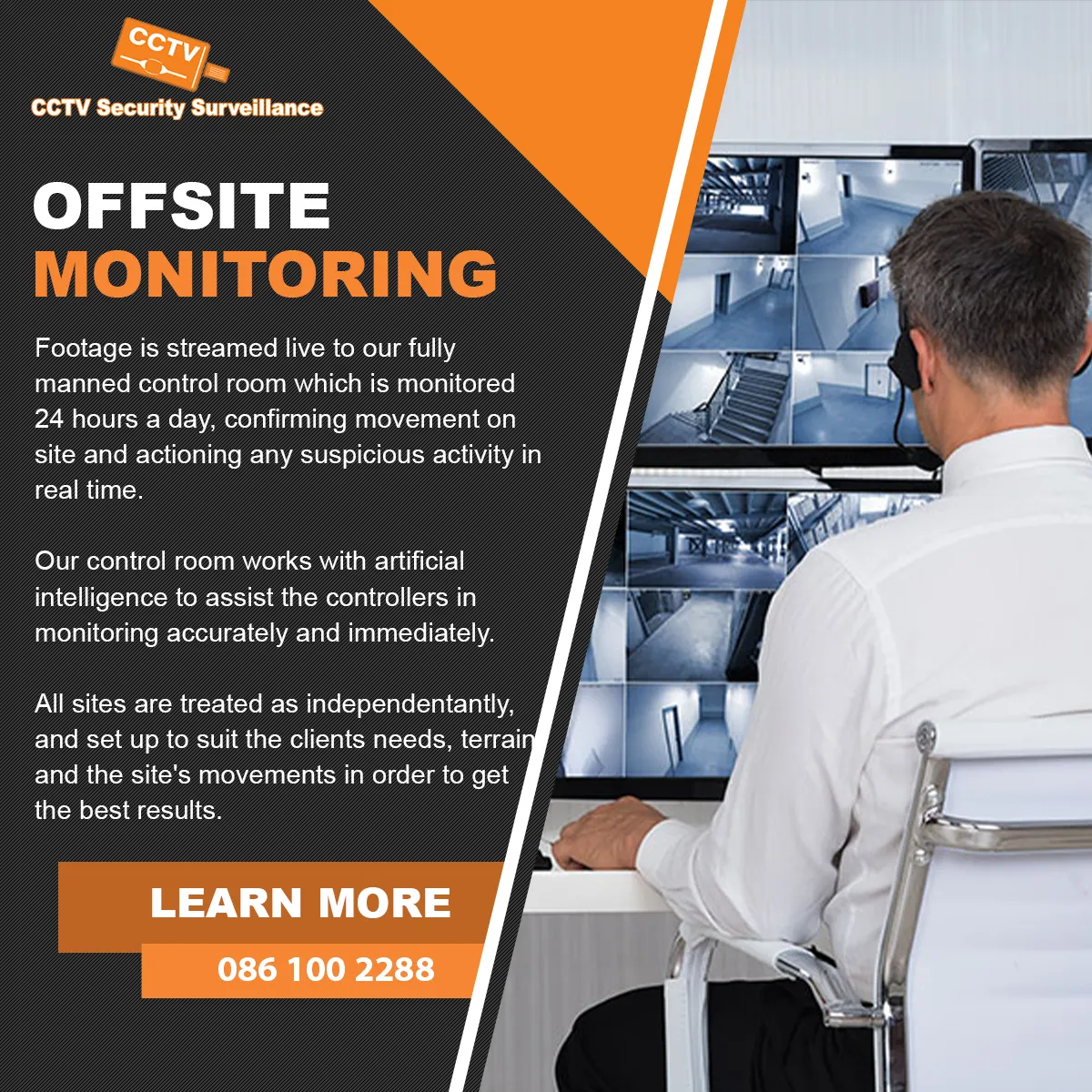
Offsite monitoring turns CCTV from a recorder into a response. A trained control room watches your cameras live, verifies every alert and acts while an incident is still happening: warning intruders, calling armed response or SAPS, and contacting your keyholders. Recorded-only CCTV can only show you what was lost.
That difference is the whole case for offsite CCTV monitoring. The cameras stay the same; what changes is that someone is watching when it matters, and they follow a response plan agreed for your site.
Key takeaways
- Offsite monitoring turns CCTV from a recorder into a response: a control room verifies every alert and acts while an incident is happening.
- Research links actively monitored CCTV to real crime reductions, while record-only systems show no significant effect.
- It covers the whole site at once, cuts false alarms with AI, and costs far less than guarding every shift.
Want a system designed around your site?
We design every system around your premises, risks and operations, starting with a free on-site assessment.
Request a Free Site AssessmentCall 0861 002 288What is offsite CCTV monitoring?
Offsite CCTV monitoring connects the cameras at your premises to a professional control room over the internet. Operators watch for genuine threats and respond according to your site's rules, so you don't have to deal with incidents yourself.
At CCTV Security Surveillance this runs from our own in-house control room, staffed 24 hours a day, every day of the year. Alerts can come from more than cameras: AI video analytics, electric fencing, alarm panels, beams and motion detectors all feed the same control room, so every event at your site is verified and acted on in one place.
Why isn't recorded-only CCTV enough?
Because footage only helps after the loss has happened. A recorder can't warn an intruder, can't call for help and can't tell you a crime is in progress. Even with clear footage of the person responsible, there is no guarantee they will be found once they have left the scene.
The gaps are the same at most sites:
- No one sees it live. Without monitoring, most incidents are discovered when someone arrives the next morning.
- Guards can't watch everything. An on-site guard can't watch every camera, entrance and alarm at once, especially on a long overnight shift.
- Alarms cry wolf. Motion-only alarms trigger on wind, animals and passing vehicles, so people stop reacting to them.
What are the main benefits of offsite monitoring?
Verified, faster response
When an alert comes in, an operator checks the live footage first. If the threat is real, they follow your documented response plan, contacting on-site security, armed response, SAPS or your designated keyholders. Nobody on site has to notice the problem first, so response starts sooner.
Fewer false alarms
AI analytics tell people, vehicles and animals apart from shadows, trees and weather. Combined with an operator who checks the footage before acting, this means real threats get attention and false alarms don't waste a call-out. Operators can also reset an alarm that was triggered by accident, directly from the control room.
Coverage of the whole site at once
A guard on foot sees one area at a time. A control room operator sees every camera angle and can direct on-site staff to an intruder's exact location, and warn them if the person is armed, so they respond safely.
Deterrence before damage
With IP speakers on site, operators can talk directly to someone on the premises and tell them they are being watched. That early warning often ends an attempted break-in before infrastructure is damaged, saving repairs and insurance claims.
Lower cost than round-the-clock guarding
Monitoring is billed as a monthly subscription. It costs far less than employing full-time security staff for every shift, and it can work alongside existing guards rather than replacing them. Some insurers may also view a monitored site as a lower risk; check with your broker what applies to your policy.
Around-the-clock attention
Most crime happens after hours, when sites are empty. Our control room is staffed at all hours, every shift is overseen by a team leader, and our own Sleep Tracker system alerts supervisors if an operator becomes fatigued or distracted.
Offsite monitoring vs on-site guards: how do they compare?
| Recorded-only CCTV | On-site guard | Offsite monitoring | |
|---|---|---|---|
| Sees incidents as they happen | No | Only where they are standing | Yes, every connected camera |
| Verifies alerts before responding | No | Sometimes | Yes, on live footage |
| Covers the whole site at once | No | No | Yes |
| Affected by fatigue on long shifts | n/a | Yes | Operators are monitored by Sleep Tracker |
| Can warn intruders remotely | No | In person only | Yes, with on-site speakers |
| Cost model | Once-off installation | Salary for every shift | Monthly subscription |
The strongest setups often combine both: guards for physical response, and a control room that tells them exactly where to go.
Who benefits most from offsite monitoring?
- Warehouses and logistics: yards, loading bays and stock areas after hours. See CCTV for logistics and warehousing.
- Retail stores and shopping centres: after-hours protection.
- Industrial and manufacturing plants: perimeters and plant areas.
- Business parks and office complexes: multi-tenant sites that empty out at night.
- Farms, estates and remote sites: large perimeters where thermal cameras with offsite monitoring work well.
What should you check before choosing a monitoring provider?
- Own control room: is it run in-house, or outsourced to a third party?
- Who watches the operators: how are fatigue and distraction managed on night shifts?
- Resilience: what keeps the control room online if a connection or server fails?
- Agreed response: is there a written response plan for your site, naming who is called and in what order?
- Your existing cameras: can the service work with them? Ours works with most systems that can provide an RTSP video stream.
- Registration: is the company PSIRA registered? CCTV Security Surveillance is registered under PSIRA 4412150 and is a SAIDSA Grade A installer.
For a look at the infrastructure behind our service, read Leading the Way in Offsite Monitoring.
What does the research say?
Actively monitored CCTV, where operators alert security or police while an incident unfolds, was associated with significant crime reductions; systems that only record showed no significant effect. (Piza et al. (2019), 40-year CCTV meta-analysis, via CrimeSolutions)
A 40-year meta-analysis of 76 CCTV evaluations found about 14% lower odds of crime in areas with CCTV than in comparable areas without it. (Piza et al. (2019), 40-year CCTV meta-analysis, via CrimeSolutions)
A US National Institute of Justice guide found that after only 20 minutes of watching and evaluating monitor screens, the attention of most people falls well below acceptable levels, which is why alert-driven monitoring and operator supervision matter. (Green (1999), National Institute of Justice)
From our projects: Automotive parts warehouse - perimeter AI & LPR
Johannesburg East Rand, completed December 2025. High-theft automotive parts warehouse with perimeter AI detection, LPR vehicle control, internal access control and 24/7 monitoring.
Cameras: 35 × 4MP + LPR + thermal · Perimeter: AI-protected
The Bottom Line
Recorded-only CCTV tells you what happened; offsite monitoring helps stop it happening. A verified, around-the-clock response, fewer false alarms and whole-site coverage make it one of the most cost-effective upgrades to an existing CCTV system.
To find out what offsite monitoring would cover at your site, request a quote or call 0861 002 288. You can also contact your nearest branch in Gauteng, KwaZulu-Natal, the Western Cape or the Eastern Cape.
Ready to put this to work on your site?
Book a free site assessment. We'll look at your premises, recommend the right system for each area and show you where it will make the biggest difference, with no obligation.
Request a Free Site AssessmentSpeak to a Security Specialist