Part of our guideOffsite Monitoring →
Thermal cameras detect the heat given off by people and vehicles, so they keep working in total darkness, fog and dense foliage where ordinary CCTV struggles. Combined with offsite monitoring, every thermal alert is checked by a control room operator and acted on immediately, which makes the pairing one of the strongest options for large perimeters.
This guide explains how thermal detection works, where it is worth the investment, and how CCTV Security Surveillance links it to our 24/7 offsite monitoring control room.
Key takeaways
- Thermal cameras detect body heat, so they work in total darkness, fog and dense foliage where ordinary CCTV fails.
- Detection range depends on lens, sensor and conditions; DRI ratings assume ideal conditions.
- Linked to a control room, every thermal alert is verified on live video and followed by a documented response.
Want a system designed around your site?
We design every system around your premises, risks and operations, starting with a free on-site assessment.
Request a Free Site AssessmentCall 0861 002 288How do thermal cameras work?
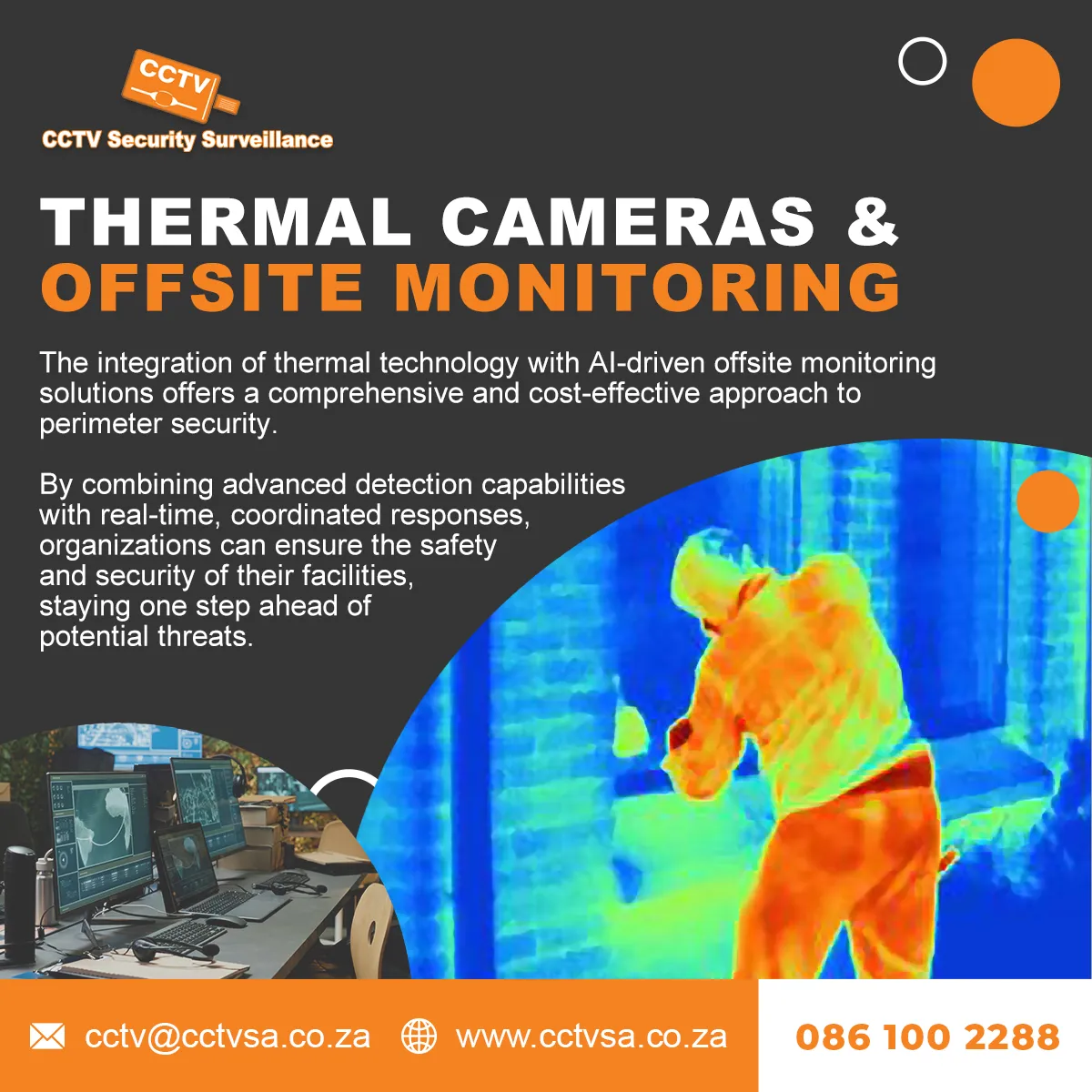
Thermal cameras detect infrared radiation (heat) instead of visible light. They build an image from the temperature differences between a person or vehicle and the background, so they don't need lighting and aren't fooled by darkness, shadows or glare.
That is why they suit sites where standard cameras fall short:
- Low or no light: unlit perimeters, farms and remote infrastructure.
- Fog, dust and smoke: conditions that wash out a normal image.
- Dense foliage: where someone could hide from a visible-light camera.
How far can a thermal camera detect a person?
It depends on the camera's lens and sensor, and on conditions. Manufacturers state range using DRI (detection, recognition and identification), based on the Johnson criteria:
| Level | What the operator can tell | Approximate pixels needed on a person |
|---|---|---|
| Detection | Something is there | About 2 pixels per metre |
| Recognition | What class it is (person or vehicle) | About 6 pixels per metre |
| Identification | Which kind within that class | About 13 pixels per metre |
Source: Infiniti Electro-Optics, DRI explained. These ratings assume ideal conditions and a 50% probability, so real-world distances are usually shorter. For perimeter alarms, detection range is what matters most: the camera's job is to raise the alert, and the control room verifies it, often with a visible-light camera alongside.
Why use thermal cameras for perimeter security?
- Reliable detection: warm objects such as people and vehicles stand out clearly, which cuts false alarms from shadows and swaying trees.
- Fewer cameras for long perimeters: thermal cameras can cover large areas and long distances, so fewer devices are needed.
- Day and night consistency: detection doesn't depend on light, so performance is the same at midday and midnight.
- Works with AI analytics: combined with AI video analytics, alerts can be limited to genuine intrusions, such as a person crossing a fence line.
How does offsite monitoring make thermal cameras more effective?
A thermal camera can detect an intruder, but someone still has to decide what to do. Linking the cameras to our control room means every detection gets a verified, coordinated response:
- A thermal camera detects a person or vehicle at the perimeter.
- The alert goes straight to our in-house control room.
- An operator, assisted by AI, checks the event against live footage.
- If the threat is real, the operator follows your site's documented response procedure, coordinating with on-site guards, SAPS, fire services or keyholders.
- Where IP speakers are installed, the operator can warn the intruder immediately that they are being watched.
What does the combination offer your business?
| Benefit | What it means on site |
|---|---|
| 24-hour monitoring | Every thermal alert is seen and assessed, day and night |
| Documented response | A standard operating procedure decides who is called and when |
| Lower guarding costs | Fewer on-site guards needed, with the control room directing those you keep |
| Scalable | More perimeters or sites can be added as you grow |
| Works with what you have | Integrates with existing cameras, access control and intrusion detection |
Where is thermal and offsite monitoring most useful?
- Farms and agricultural land: long, unlit boundaries. See protecting your farm with CCTV.
- Industrial sites and plants: large yards and fence lines after hours.
- Substations and solar plants: remote infrastructure targeted for cable and equipment theft.
- Critical infrastructure and data centres: high-security perimeters that must be watched continuously.
Thermal imaging also has uses beyond security, such as monitoring equipment temperature to catch overheating before it causes a failure.
What should you check before installing thermal perimeter cameras?
- Detection range: is the stated detection distance enough for the length of your perimeter, allowing for real-world conditions?
- Analytics: can alerts be limited to people or vehicles crossing a defined line?
- Verification: is there a visible-light camera or a monitored response to confirm each alert?
- Power and connectivity: can remote cameras stay online through load-shedding and outages?
- Response plan: who is called, in what order, when an intrusion is confirmed?
What does the research say?
Actively monitored CCTV, where operators alert security or police while an incident unfolds, was associated with significant crime reductions; systems that only record showed no significant effect. (Piza et al. (2019), 40-year CCTV meta-analysis, via CrimeSolutions)
The same meta-analysis found about 16% lower odds of property crime and of vehicle crime, the offences where cameras have the clearest effect. (Piza et al. (2019), 40-year CCTV meta-analysis, via CrimeSolutions)
CCTV combined with other measures such as access control, lighting or guarding produced larger effects than cameras alone, and the researchers advise against using CCTV as a stand-alone measure. (Piza et al. (2019), Criminology & Public Policy)
From our projects: Gated estate - perimeter AI & access control
Johannesburg North, completed September 2025. Commercial gated estate with perimeter AI protection, LPR vehicle control, common area surveillance and 24/7 monitoring.
Cameras: 56 × 4MP + thermal + LPR · Properties: 240 units
The Bottom Line
Thermal cameras see intruders that ordinary cameras miss, and offsite monitoring makes sure every detection is verified and acted on. For farms, industrial perimeters and remote infrastructure, the combination gives reliable 24/7 protection with fewer cameras and fewer false alarms.
To plan thermal perimeter protection for your site, request a quote or call 0861 002 288. You can also contact your nearest branch in Gauteng, KwaZulu-Natal, the Western Cape or the Eastern Cape.
Ready to put this to work on your site?
Book a free site assessment. We'll look at your premises, recommend the right system for each area and show you where it will make the biggest difference, with no obligation.
Request a Free Site AssessmentSpeak to a Security Specialist