Part of our guideVideo Analytics →
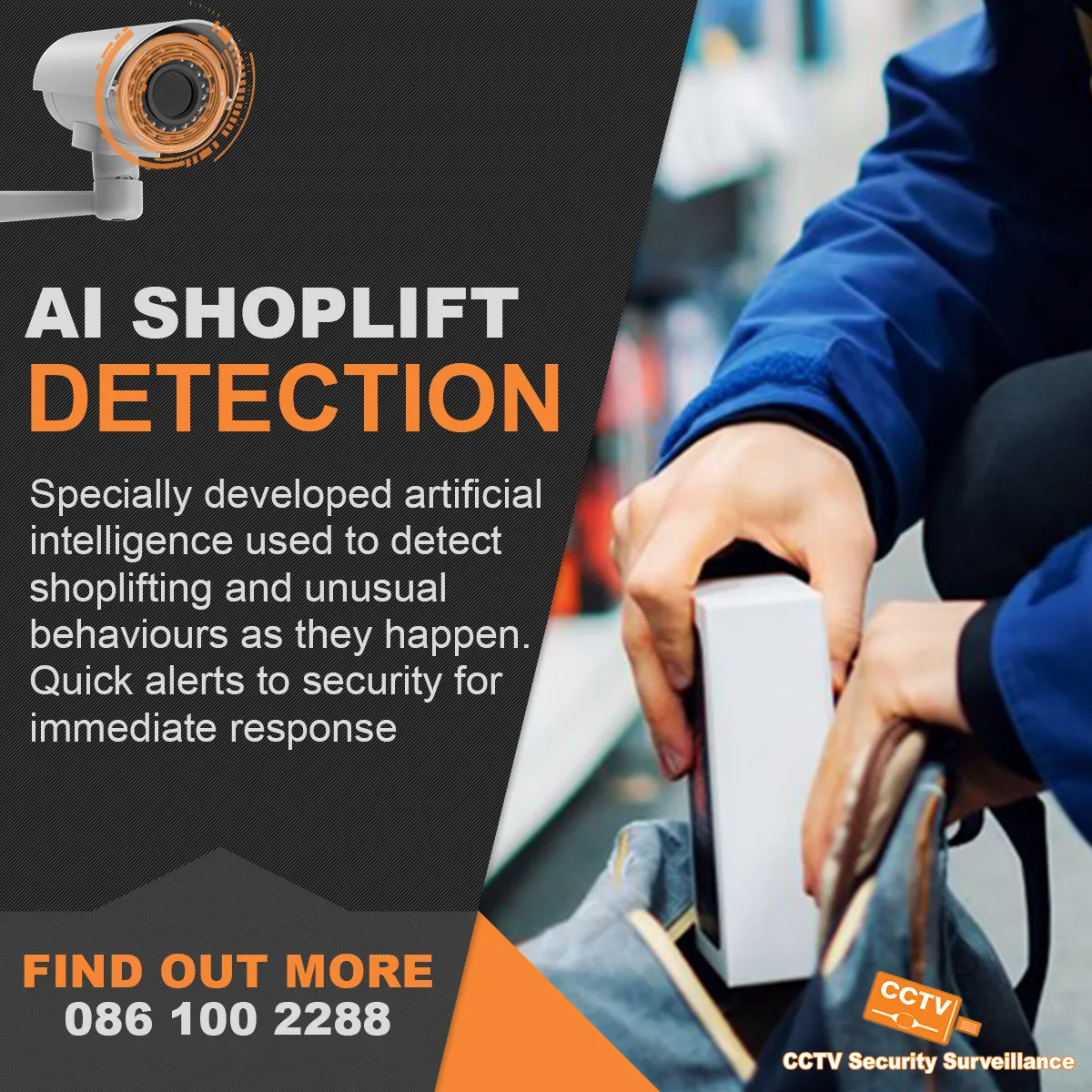
AI shoplift detection is software that watches selected store cameras for gestures and behaviour linked to shoplifting, and alerts staff with real-time footage as it happens. Staff review each alert, act if needed, and log the outcome, which the system uses to keep improving its detection. It runs on existing CCTV cameras in the background.
It is the technology behind our AI shoplift detection service, part of our wider AI video analytics.
Key takeaways
- AI trained on theft gestures watches selected cameras and alerts staff in real time.
- Staff review each alert and log the outcome, which helps the system keep improving.
- It runs on existing cameras, so stores upgrade intelligence rather than hardware.
Want a system designed around your site?
We design every system around your premises, risks and operations, starting with a free on-site assessment.
Request a Free Site AssessmentCall 0861 002 288What is AI shoplift detection?
It is an AI system trained to recognise suspicious gestures and body language that often come before a theft, such as concealing an item. It monitors many cameras at once and alerts the security team, with the aim of stopping the theft before the person leaves the store.
Why do retailers need it?
Most stores can't afford enough staff to watch every camera at all times. Shoplifting goes unnoticed until stock counts don't add up. AI watches the cameras continuously while staff get on with serving customers and other tasks.
How does the system learn?
The AI is trained on examples of suspicious gestures and behaviour. In use, it works in a loop:
| Step | What happens |
|---|---|
| 1. Detect | The AI spots a gesture or behaviour linked to theft on a camera |
| 2. Alert | Staff receive the real-time footage |
| 3. Review | Staff decide whether action is needed |
| 4. Log | The outcome is recorded as "theft stopped", "theft escaped" or "no further action" |
| 5. Learn | Logged outcomes help the system improve future detection |
The more alerts are reviewed and logged, the better the system gets at telling real threats from normal shopping.
What are the benefits?
- Continuous monitoring of selected cameras without extra staff;
- Real-time alerts, so staff can step in before stock leaves;
- Improving accuracy as logged outcomes feed back into the system;
- Lower cost than employing enough people to watch every camera;
- Uses existing cameras, so stores upgrade intelligence rather than hardware.
For how retailers use these alerts on the shop floor, read a smarter way for retailers to prevent loss.
How does it fit with other retail technology?
- Till queue systems for queue management at checkouts;
- POS integration to link transactions to video and catch till fraud;
- Heat mapping to see how shoppers move through the store;
- How AI helps retail for the full picture.
What should you check before installing it?
- Which cameras to analyse: high-risk aisles, high-value shelves and blind spots.
- Image quality: the AI needs a clear view of hands and shelves.
- Who reviews alerts: and how quickly they can respond.
- Logging discipline: outcomes must be logged consistently so the system keeps improving.
- POPIA: display signage and keep footage secure and for a defined period. See the Information Regulator.
What does the research say?
The US National Retail Federation found average retail shrink rose to 1.6% in fiscal 2022, about US$112.1 billion in losses, with internal and external theft causing about 65% of it. (NRF (2023), National Retail Security Survey)
A randomised controlled trial across 47 retail stores found positive evidence that visible in-aisle cameras and public-view monitors reduce opportunities for theft in real store conditions. (Hayes & Downs (2011), Security Journal)
Actively monitored CCTV, where operators alert security or police while an incident unfolds, was associated with significant crime reductions; systems that only record showed no significant effect. (Piza et al. (2019), 40-year CCTV meta-analysis, via CrimeSolutions)
From our projects: Convenience store chain - countermeasure rollout
Cape Town metro, completed June 2025. Standardised CCTV rollout across 24 convenience stores - unified equipment, centralised monitoring, AI detection and POS integration.
Stores: 24 locations · Cameras per store: 6-8 × 4MP IP
The Bottom Line
AI shoplift detection watches your cameras so your staff don't have to, alerts them while there is still time to act, and gets better with every alert they log. It turns existing CCTV into an active loss-prevention tool.
To find out how it would work in your store, request a quote or call 0861 002 288. You can also contact your nearest branch in Gauteng, KwaZulu-Natal, the Western Cape or the Eastern Cape.
Ready to put this to work on your site?
Book a free site assessment. We'll look at your premises, recommend the right system for each area and show you where it will make the biggest difference, with no obligation.
Request a Free Site AssessmentSpeak to a Security Specialist