
Part of our guideCCTV Systems →
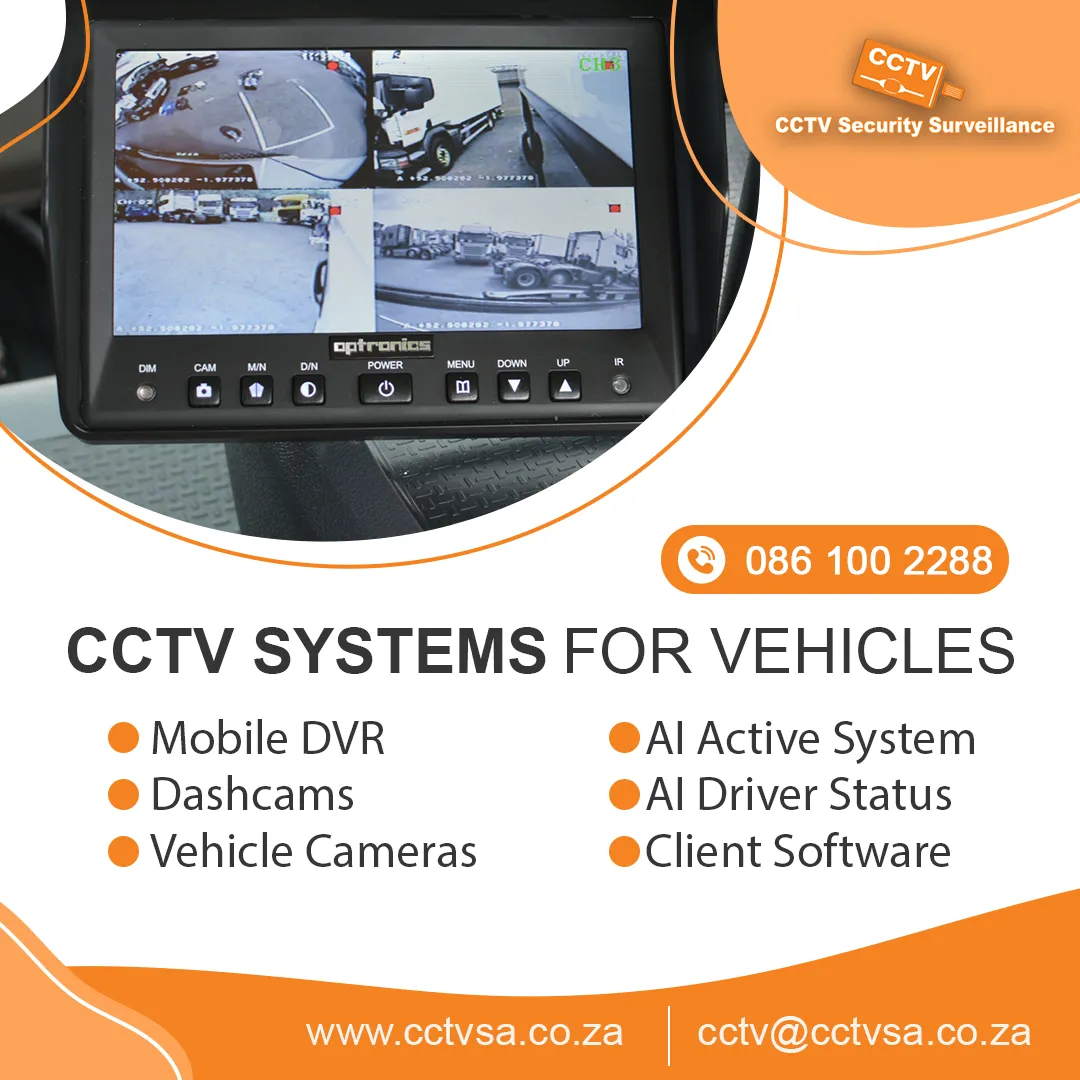
A vehicle CCTV system records what happens around and inside a vehicle, using a mobile DVR connected to a dashcam and cameras on the sides and rear. AI features can alert you to attempted break-ins and monitor the driver for fatigue, and client software lets fleet managers view live and recorded footage remotely.
For fleets, delivery vehicles and cash-carrying vehicles, it extends the same protection as fixed CCTV systems to assets that are always on the move.
Key takeaways
- A mobile DVR records the dashcam and side and rear cameras, so every trip and incident is captured.
- AI can alert on attempted break-ins and monitor drivers for fatigue before it causes an accident.
- Fleet managers view live and recorded footage and receive alerts remotely on a computer or phone.
Want a system designed around your site?
We design every system around your premises, risks and operations, starting with a free on-site assessment.
Request a Free Site AssessmentCall 0861 002 288What are the parts of a vehicle CCTV system?
| Component | What it does |
|---|---|
| Mobile DVR | The in-vehicle recorder that stores footage from all connected cameras |
| Dashcam | Records the road ahead continuously |
| Vehicle cameras | Side and rear cameras that remove blind spots around the vehicle |
| AI active system | Analyses video for threats, such as attempts to break into the vehicle |
| AI driver status | Monitors the driver for signs of fatigue or distraction |
| Client software | Lets you view live and recorded footage and receive alerts remotely |
What does a mobile DVR do?
The mobile DVR is the heart of the system. It is a compact, rugged recorder built to cope with vehicle vibration, and it records footage from every connected camera so that incidents and accidents are captured for review.
Why add cameras beyond a dashcam?
A dashcam records the road ahead, which helps establish what happened in a collision. Cameras on the sides and rear cover the blind spots around the vehicle, which matters for reversing, loading and unloading, and for seeing who approaches the vehicle when it is parked.
How does AI improve vehicle security?
Threat detection
AI analyses video in real time and can recognise attempts to access the vehicle, triggering an alert to the owner or a monitoring centre.
Driver fatigue monitoring
AI driver status monitoring watches for signs of fatigue or impairment and can warn the driver, for example by suggesting a break. On long-distance routes, this helps prevent fatigue-related accidents. It applies the same idea as our control room operator monitoring: catching tiredness before it causes harm.
How do fleet managers use the footage?
Client software on a computer or phone lets managers:
- view live video from vehicles on the road;
- review recorded footage after an incident or complaint;
- receive alerts when the AI detects a threat or driver fatigue;
- change system settings remotely.
Who benefits from vehicle CCTV?
- Logistics and delivery fleets: evidence for accidents, cargo disputes and theft. See CCTV for logistics and warehousing.
- Passenger transport: recording inside and around buses and shuttles.
- Security and cash vehicles: footage of anyone approaching the vehicle.
- Mining and construction vehicles: blind-spot coverage on large machines.
What should you check before fitting vehicle CCTV?
- Camera coverage: which angles matter, front, sides, rear or cab?
- Recording time: how much storage is needed between downloads?
- Live viewing: do you need live access, which requires mobile data?
- Driver monitoring: how will fatigue alerts be handled, and by whom?
- POPIA and labour rules: tell drivers about in-cab recording and its purpose, and restrict who can view footage. See the Information Regulator.
What does the research say?
The same meta-analysis found about 16% lower odds of property crime and of vehicle crime, the offences where cameras have the clearest effect. (Piza et al. (2019), 40-year CCTV meta-analysis, via CrimeSolutions)
The ACFE's 2026 study of 2,402 occupational fraud cases found the median scheme ran 12 months before detection, and proactive data monitoring was associated with lower losses and faster detection. (ACFE (2026), Occupational Fraud 2026: A Report to the Nations)
A US National Institute of Justice guide found that after only 20 minutes of watching and evaluating monitor screens, the attention of most people falls well below acceptable levels, which is why alert-driven monitoring and operator supervision matter. (Green (1999), National Institute of Justice)
From our projects: Port-adjacent distribution centre - chain-of-custody
Durban Port, KZN, completed April 2026. AI-powered chain-of-custody system for a port-adjacent distribution centre - LPR at gates, scale integration in receiving, PPE detection on forklifts, perimeter AI and 24/7 monitoring.
Cameras: 42 × 4MP + LPR · Receiving docks: 4 with scale integration
The Bottom Line
Vehicle CCTV gives fleets a record of every trip and incident, with AI that warns of threats and tired drivers, and software that puts every vehicle in view. It protects drivers, cargo and the business when disputes or accidents happen.
To plan vehicle CCTV for your fleet, request a quote or call 0861 002 288. You can also contact your nearest branch in Gauteng, KwaZulu-Natal, the Western Cape or the Eastern Cape.
Ready to put this to work on your site?
Book a free site assessment. We'll look at your premises, recommend the right system for each area and show you where it will make the biggest difference, with no obligation.
Request a Free Site AssessmentSpeak to a Security Specialist