
Part of our guideIntegrated Security →
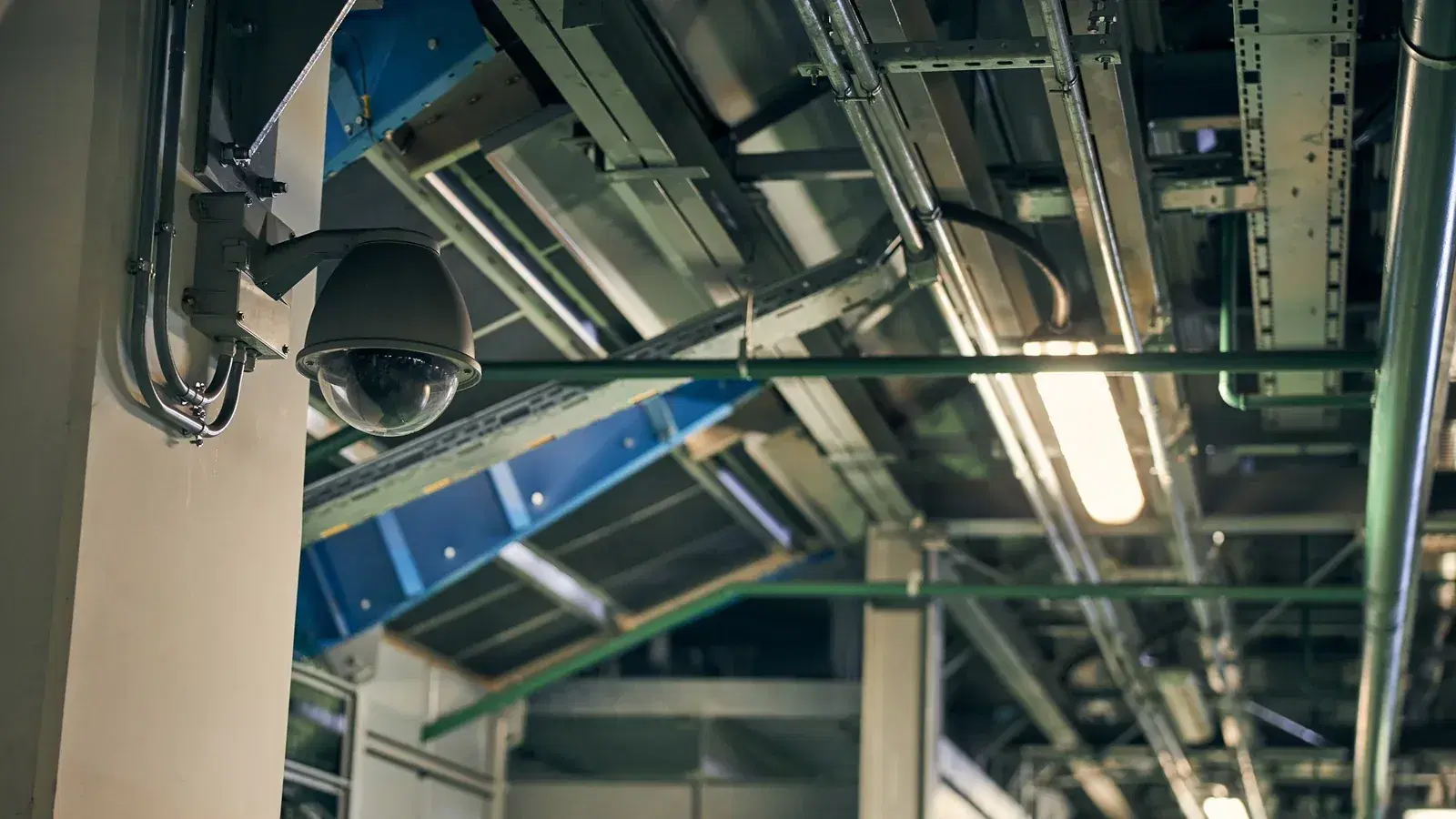
Integrated security for factories links CCTV, access control, perimeter alarms and 24/7 monitoring into one system run by one accountable provider, so an alarm at a gate or store arrives with video and a response. It matters most when a plant empties, such as over the December shutdown, and when systems have aged separately.
This guide is for plant and operations managers deciding whether to appoint one provider. Our integrated security solutions page explains the full system; here we focus on what changes inside a plant. For the sector overview, see our factory security page.
Key takeaways
- Linking systems gives one record of what happened: video, door events and alarms on one timeline.
- A shutdown changes the risk: fewer people on site, more contractors and stock left standing, so plan cover before the plant closes.
- Ageing analogue CCTV does not always need replacing at once: a phased upgrade can reuse some of what is there.
Want a system designed around your site?
We design every system around your premises, risks and operations, starting with a free on-site assessment.
Request a Free Site AssessmentCall 0861 002 288What does integrated security for factories include?
Integrated security solutions for a factory normally combine CCTV, access control, perimeter detection and offsite monitoring on one platform, with one provider answering for how they work together. Depending on the plant, it can also connect to fire detection, weighbridges and production systems.
| Plant area | Typical risk | System that helps | What linking it adds |
|---|---|---|---|
| Perimeter and yard | After-hours intrusion | Electric fencing, perimeter analytics, CCTV | A fence alarm opens the nearest camera for the operator |
| Gates and dispatch | Vehicle and load theft | ANPR, weighbridge integration, CCTV | Footage can be checked against vehicle and weight records |
| Stores and restricted zones | Internal theft, unauthorised entry | Access control, CCTV | Each door event can be checked against video |
| Production floor | Safety incidents, disputes between shifts | CCTV, PPE detection | Footage supports incident investigation |
| Plant and switchgear | Fire and overheating | Fire detection, thermal cameras | Early warning can reach the control room |
We wrote separately about why integrated CCTV matters for South African manufacturing, including how video links to ERP and weighbridge records. If you are comparing providers, read how to choose a security integrator.
What does one provider change for a plant manager?
One provider gives a plant manager a single contract and a single number to call when something fails, instead of separate suppliers for cameras, doors, fence and response. That matters most during an incident, when nobody should be arguing about whose system is at fault.
In practice, ask for one service agreement, one fault-reporting route and one record of alarms. Ask the provider to show who designs, installs, monitors and maintains each part, and which parts it subcontracts.
What happens during a plant shutdown?
During a plant shutdown, production stops and most staff leave, while stock, equipment and sometimes maintenance contractors remain on site. Normal shift patterns no longer provide the eyes and routines a plant relies on, so factory shutdown security has to be planned as its own period.
Three things change at once. The site is quieter, so unusual activity has fewer witnesses. Contractors may need access outside normal routines, so access rights change. And key people may be away, so the call-out list that works in October may fail in December.
How do you secure a factory over the December shutdown?
Secure a factory over the December shutdown by agreeing the cover, access rights and call-out list before the plant closes, then testing them while people are still on site. Waiting until the last week leaves no time to fix a faulty camera or a dead battery.
These factory shutdown security examples show the kinds of steps to plan:
- Move finished goods and high-value stock into the areas with the best coverage, where production allows.
- Issue temporary access for each contractor, with an end date, and suspend access for people who do not need it.
- Agree the response plan with the control room, including who is called and in what order, and update the keyholder list for the holidays.
- Test what will be relied on: alarms, cameras, links to the control room and backup power.
- Tell your insurer. Cover conditions can change when premises stand empty. Aviva's UK guidance warns that insurance may be invalid if the insurer is not told, so confirm what your South African broker requires. (Aviva)
Do factories have security guards, or is virtual guarding enough?
Many factories use on-site guards, and virtual guarding can replace or reduce them depending on the risk, the site and the response available. Virtual guarding means trained operators protect a site remotely through its cameras instead of patrolling on foot, and it is a form of offsite CCTV monitoring.
| Option | Strength | Limit | Suits |
|---|---|---|---|
| On-site guards | Physical presence and deterrence | See one area at a time | Gates, and sites that need someone present |
| Virtual guarding | Every connected camera watched from a control room | Needs a response partner to act physically | Large perimeters and empty plants |
| Armed response | Sends a vehicle after a signal | Needs a reliable alarm or verified signal | Backing up monitoring or alarms |
| Combination | The control room directs guards or responders to the exact location | Needs one agreed plan | Higher-risk plants during a shutdown |
For budgets, our guide to CCTV monitoring cost compares published monthly prices for monitoring and guards.
IP or analogue CCTV: when should you upgrade?
Upgrade analogue CCTV when it can no longer identify what you need it to identify, when spare parts are running out, or when you want analytics and integration it cannot support. IP CCTV sends each camera's video over a data network to a recorder or VMS (video management system), while analogue CCTV sends it over coaxial cable to a DVR.
| Older analogue | HD-TVI (HD over coax) | IP | |
|---|---|---|---|
| Cabling | Coax | Reuses coax | Network cable or fibre |
| Image detail | Lowest | Higher, depending on the camera | Higher, depending on the camera |
| Analytics | Limited | Depends on the recorder | Widest choice, on camera or recorder |
| Linking to other systems | Limited | Limited | Designed for network integration |
An HD-TVI vs IP decision usually comes down to the cabling you have and how much you want to link. An analogue to IP upgrade does not have to happen in one go: a commercial CCTV system upgrade can start at the highest-risk areas and reuse sound cabling until each phase is due. Shutdown can be a good time for this work, because cabling and access are easier when production has stopped.
What should you check before appointing one provider?
Check that one provider can design, install, monitor and maintain the whole system before you appoint it, and that it can show this on real industrial work.
- Registered with the Private Security Industry Regulatory Authority (PSIRA), and the number checks out.
- Runs its own control room, or tells you who does.
- Can show manufacturing projects similar to your plant.
- Has a written shutdown plan, with dates, contacts and test results.
- Has a response plan that names who is called, and in what order.
- Sets a purpose, signage, retention period and viewing limits for footage of staff, as POPIA, the Protection of Personal Information Act, requires for personal information.
- Offers a maintenance agreement. See maintenance and rental agreements.
- Covers your other sites, if you run more than one.
What does the research say?
South African police statistics recorded 10,721 business burglaries from April to June 2026, down 1.5% on the same quarter a year earlier. (South African Police Service, crime statistics)
A 40-year meta-analysis of 76 CCTV evaluations found about 14% lower odds of crime in areas with CCTV than in comparable areas without it. (Piza et al. (2019), via CrimeSolutions)
The ACFE's 2026 study of 2,402 occupational fraud cases found the median scheme ran 12 months before detection. (ACFE (2026), Occupational Fraud 2026: A Report to the Nations)
From our projects: Food manufacturing facility - production line safety
Westville, Durban, completed February 2026. Food manufacturing facility with AI-powered production line monitoring, PPE detection, access control and 24/7 offsite surveillance.
Cameras: 6 × 4MP IP
From our projects: Automotive parts factory - safety & compliance
East Rand, Johannesburg, completed April 2026. Automotive parts factory with CCTV on the production line, safety zones and access control.
Cameras: 36 × 4MP IP
The Bottom Line
For a plant, integration is about having one record and one accountable provider when something goes wrong, and the December shutdown is when that gets tested. Agree the cover and test it before the plant closes.
Book a security risk assessment or call 0861 002 288. For factory security in Johannesburg, contact our Gauteng branch; for factory security in Durban, our KwaZulu-Natal branch; for factory security in Cape Town, our Western Cape branch; and for factory security in Gqeberha, our Eastern Cape branch.
Ready to put this to work on your site?
Book a free site assessment. We'll look at your premises, recommend the right system for each area and show you where it will make the biggest difference, with no obligation.
Request a Free Site AssessmentSpeak to a Security Specialist