
Part of our guideCCTV Systems →
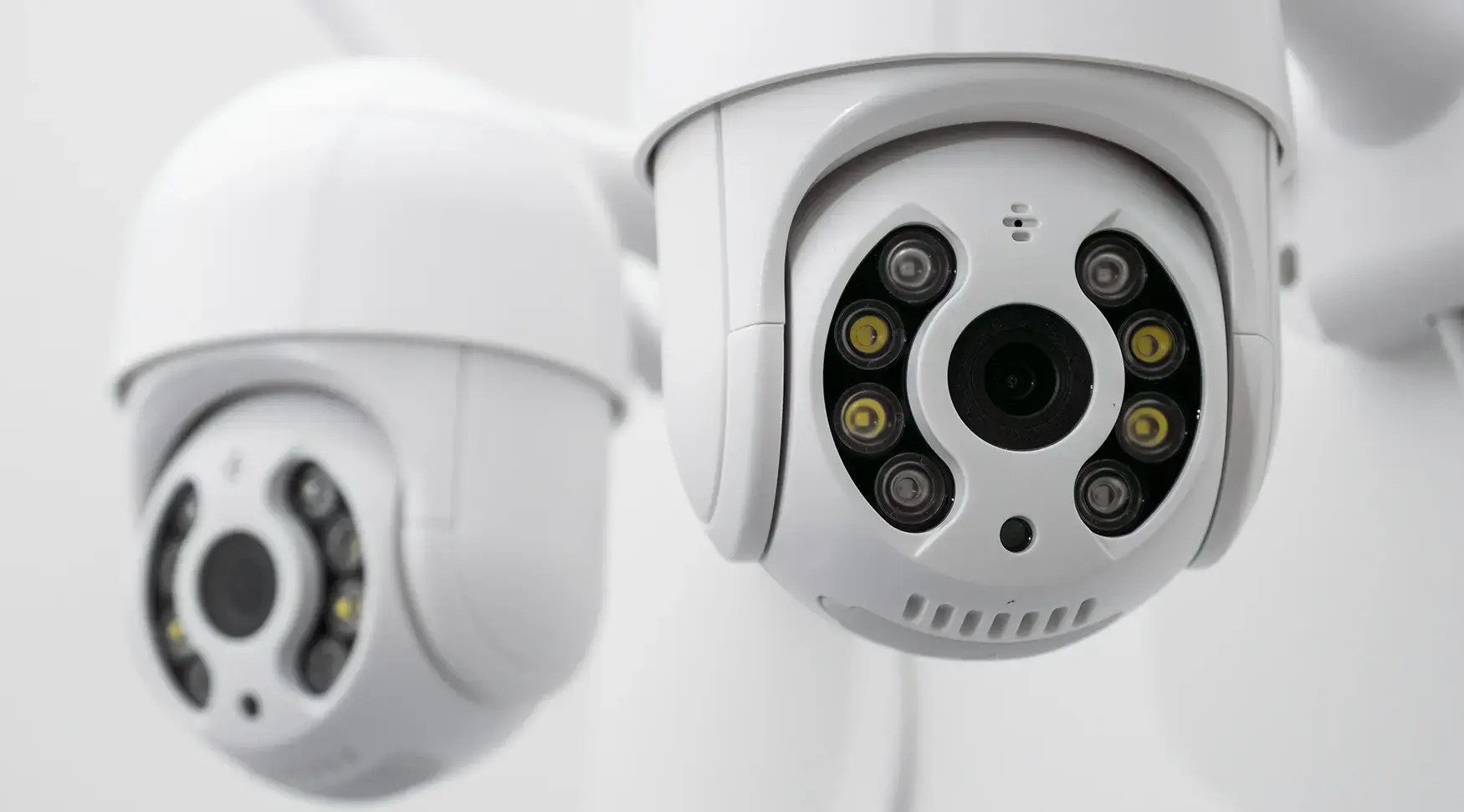
IP cameras are digital security cameras that send video over a computer network, so one network cable carries both power and a high-resolution image to a network video recorder. For most business sites they are the better choice than analogue cameras, and on our 2027 price guide a standard 4MP IP camera costs R2,500 to R5,500 per point supplied and installed.
This 2027 guide is for facilities and IT managers deciding whether to keep, extend or replace an analogue system. It explains how IP and analogue differ, what an IP system costs, what can be reused, and when an upgrade pays for itself as part of commercial CCTV systems for your site.
Key takeaways
- A standard 4MP IP camera point costs R2,500 to R5,500, and an advanced point (LPR, thermal or analytics) R8,000 to R25,000+, on our 2027 price guide.
- IP cameras run power and video over one network cable (PoE) and support AI analytics, LPR and multi-site viewing.
- Upgrade when analogue cameras can no longer identify faces or plates, fail often, or cannot run the analytics you need.
Want a system designed around your site?
We design every system around your premises, risks and operations, starting with a free on-site assessment.
Request a Free Site AssessmentCall 0861 002 288What are IP cameras?
An IP (internet protocol) camera is a camera that turns its image into digital data inside the camera and sends it over a network, like any other networked device. PoE (power over Ethernet) means the same network cable also powers the camera, so no separate power supply is needed at each camera.
The video goes to an NVR (network video recorder), the box that records and stores footage from IP cameras, or to cloud storage. Because each camera is a network device, IP cameras can be viewed remotely, linked to video analytics and connected to a monitoring control room without extra hardware.
What is the difference between IP and analogue CCTV cameras?
The main difference between IP and analogue CCTV cameras is where the image is processed: an IP camera sends digital video over a network cable, while an analogue camera sends an analogue signal over coaxial cable to a DVR (digital video recorder) that digitises it.
| IP cameras | HD analogue cameras | |
|---|---|---|
| Signal | Digital, over a network | Analogue, over coaxial cable |
| Cabling | One Cat6 cable for power and video (PoE) | Coaxial cable plus separate power |
| Recorder | NVR or cloud | DVR (or a hybrid recorder) |
| Resolution | 4MP is standard; higher is available | Lower in practice |
| AI analytics, LPR, thermal | Supported | Limited |
| Remote and multi-site viewing | Built in | Possible, more limited |
| Network security | Needs a protected camera network | Fewer network risks, fewer features |
| Best for | New systems and upgrades | Small sites reusing existing coax |
For the full picture of a business system, including recording, power and monitoring, see our guide to camera systems for business.
What does an IP camera system cost for a business?
On our 2027 price guide, IP camera systems for commercial and industrial sites cost:
| Item (supplied and installed) | 2027 guide price |
|---|---|
| Standard 4MP IP camera | R2,500 – R5,500 per point |
| Advanced or AI camera (LPR, thermal, analytics) | R8,000 – R25,000+ per point |
| Cat6 cabling and containment | R850 – R1,500 per point |
| NVR, 8 channel | R6,000 – R12,000 |
| NVR, 16 channel | R12,000 – R25,000 |
| NVR, 32 channel (AI-capable) | R25,000 – R60,000 |
| Small commercial site, 4–8 IP cameras | R25,000 – R60,000 |
| Medium commercial site, 8–16 IP cameras | R60,000 – R150,000 |
Source: CCTVSA 2027 price guide, indicative averages. See the full CCTV installation price guide and our CCTV for business pricing guide.
When is it worth upgrading from analogue to IP?
Upgrading from analogue to IP is worth it when the cameras no longer do the job the business needs. The usual signs are:
- You cannot identify people or plates: incidents are recorded but faces and number plates are too blurred to use.
- Cameras and DVRs keep failing: repairs and call-outs are rising on ageing equipment.
- You need analytics: perimeter alerts, LPR, PPE detection or AI CCTV need IP cameras.
- You want monitoring or multi-site viewing: a control room or head office needs clean, reliable video from every site.
- You are extending the site: new buildings, yards or lines are a natural point to move to IP.
Can IP cameras use the existing coax cabling?
Sometimes. Ethernet-over-coax adapters can carry IP video and power over existing coaxial cable, which can save cabling cost where cable runs are hard to replace. New Cat6 cabling is usually the more reliable long-term choice, and a hybrid recorder can run old analogue and new IP cameras side by side while you upgrade in stages.
| Upgrade route | When it suits | Trade-off |
|---|---|---|
| Full IP replacement with new Cat6 | Most sites; failing or low-quality analogue | Highest upfront cost, best result |
| Staged upgrade on a hybrid recorder | Budget spread over time; mixed old and new areas | Two technologies to maintain for a while |
| IP over existing coax (adapters) | Hard-to-replace cable runs | Adapter cost; cable condition limits reliability |
How many IP cameras can an NVR support?
An NVR supports as many IP cameras as it has channels: an 8-channel NVR records 8 cameras, a 16-channel NVR 16 and so on, provided its bandwidth and storage are sized for them. Plan spare channels for growth, and size storage for the resolution, frame rate and retention period you need. Ask each installer to state these, because storage is the item most often left vague in quotes. See CCTV cloud recording and storage.
What should you check before buying IP cameras for business?
- Resolution and lens per zone: 4MP or higher, and the right lens to identify at doors and gates.
- Night performance: infrared range or colour night vision for each outdoor zone.
- PoE switch capacity: enough PoE power and ports, with a UPS.
- Network security: a separate camera network, changed default passwords and current firmware. See network security in surveillance.
- NVR channels and storage: spare channels and storage sized for your retention period.
- Analytics: whether the cameras and NVR support the analytics you need now or later.
- Monitoring: whether the system can connect to a 24/7 control room.
- Installer credentials: PSIRA registration; CCTVSA is PSIRA 960468 and 4412150 and SAIDSA Grade A (ASP-1571).
What does the research say?
A 40-year meta-analysis of CCTV found about 16% lower odds of property crime and of vehicle crime. (Piza et al. (2019), via CrimeSolutions)
The same review found that actively monitored CCTV was associated with significant crime reductions, while systems that only record showed no significant effect. (Piza et al. (2019), Criminology & Public Policy)
ONVIF, the standards body for interoperable IP security products, is deprecating Profile S, its original video streaming profile, with 31 March 2027 the last date for product conformance submissions. Profile T covers advanced streaming such as H.264/H.265 encoding, imaging settings, motion and tampering events and two-way audio, so new IP cameras for a business should list Profile T conformance. (ONVIF Profile S; ONVIF Profile T)
The Bottom Line
IP cameras give businesses clearer evidence, analytics and monitoring that analogue cannot match, at R2,500 to R5,500 per standard point on our 2027 price guide. If your analogue system no longer identifies people or keeps failing, an upgrade, in one go or in stages, is usually the better spend than further repairs.
To plan an upgrade, request a quote or call 0861 002 288. We install IP cameras in Johannesburg from our Gauteng branch, IP cameras in Durban from KwaZulu-Natal, IP cameras in Cape Town from the Western Cape, and IP cameras in Gqeberha from the Eastern Cape.
Ready to put this to work on your site?
Book a free site assessment. We'll look at your premises, recommend the right system for each area and show you where it will make the biggest difference, with no obligation.
Request a Free Site AssessmentSpeak to a Security Specialist