
Part of our guideInverters & Solar Solutions →
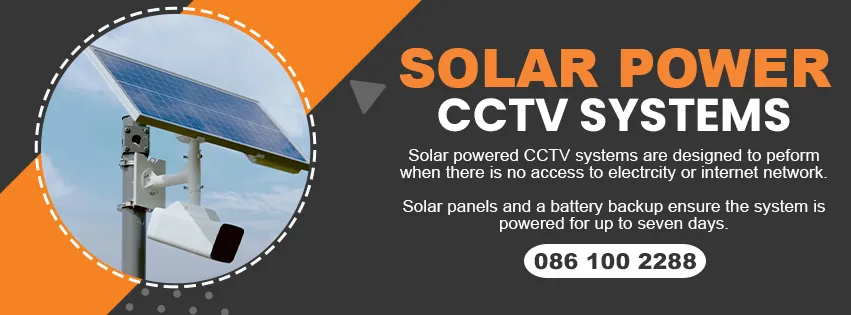
Solar-powered CCTV runs cameras from solar panels and batteries instead of mains electricity, and sends footage over mobile networks such as 4G LTE instead of network cables. That makes it practical for construction sites, temporary structures, remote buildings, farms and any site where load-shedding or a lack of infrastructure would otherwise leave cameras dark.
Solar CCTV is one of the options we use when planning a CCTV installation for sites where running power and data cables is impractical or expensive.
Key takeaways
- Solar CCTV runs on panels and batteries and connects over 4G, so it needs no power or network cables.
- With load-shedding on 287 days of 2023, independent power keeps cameras recording when the grid is down.
- Size panels and batteries for winter, check mobile signal at each camera, and keep panels clean.
Want a system designed around your site?
We design every system around your premises, risks and operations, starting with a free on-site assessment.
Request a Free Site AssessmentCall 0861 002 288How does solar-powered CCTV work?
A solar panel converts sunlight into electricity, which powers the camera and charges a battery. The battery stores the surplus so the camera keeps running at night and on cloudy days. Many models are rated to run for several days without direct sun; check the rating of the specific model for your site.
For connectivity, solar cameras typically connect over mobile networks (GSM, WCDMA or 4G LTE), so footage can be viewed remotely or sent to a control room without any cabling.
What are the benefits of solar-powered CCTV?
- Works without mains power: ideal where there is no electrical supply, or where load-shedding interrupts it.
- Quick installation: no trenching for power or network cables, which saves time and cost.
- Easy to move: units can be relocated as a construction project progresses or a temporary site changes.
- Weather-resistant: built for outdoor conditions, including wind and storms.
- Battery backup: stored energy covers nights, cloudy weather and dust on the panels.
Where does solar CCTV make sense?
| Site | Why solar works |
|---|---|
| Construction sites | Temporary, no permanent power, equipment and materials at risk |
| Farms and agricultural land | Long distances from power and network points. See farm CCTV |
| Remote buildings and infrastructure | Expensive to run cables; often unmanned |
| Perimeters and gates far from buildings | Avoids long cable runs |
| Sites affected by load-shedding | Keeps cameras running when the grid is down |
How do you keep solar CCTV reliable?
Size the panel and battery for winter
Panels produce less in winter and in overcast weather. The system should be sized for the shortest days, not the sunniest.
Plan for mobile signal
Check signal strength at the exact camera position. Weak coverage can limit live viewing and remote access.
Keep panels clean
Dust and dirt reduce output, especially on farms and construction sites. Include panel cleaning in routine maintenance; see our maintenance and rental agreements.
Protect the equipment
Mount panels and cameras high enough, and securely enough, to deter theft and vandalism.
Can solar CCTV be monitored?
Yes. Solar cameras can send alerts and footage to our offsite monitoring control room, where operators verify events and respond. For long, dark perimeters, see how thermal cameras work with offsite monitoring. Footage can also be stored offsite with cloud recording.
What should you check before choosing solar CCTV?
- Sunlight: is the panel position in full sun for most of the day, all year?
- Battery autonomy: how many days will it run without sun?
- Mobile coverage: is there reliable 4G signal at each camera position?
- Data costs: how much footage will be uploaded each month?
- Security of the unit: how will panels and cameras be protected from theft?
What does the research say?
South Africa had load-shedding on 287 days of 2023 by mid-December, a total of 6,894 hours, against 157 days in 2022, according to EskomSePush data. (Daily News (2023), citing EskomSePush)
The same meta-analysis found about 16% lower odds of property crime and of vehicle crime, the offences where cameras have the clearest effect. (Piza et al. (2019), 40-year CCTV meta-analysis, via CrimeSolutions)
Actively monitored CCTV, where operators alert security or police while an incident unfolds, was associated with significant crime reductions; systems that only record showed no significant effect. (Piza et al. (2019), 40-year CCTV meta-analysis, via CrimeSolutions)
From our projects: Wine estate - vineyard protection & winery security
Constantia, Cape Town, completed August 2025. Wine estate with CCTV covering vineyards, winery, cellar and perimeter.
Cameras: 36 × 4MP IP · Vineyard area: 45 hectares
The Bottom Line
Solar-powered CCTV brings surveillance to places without power or cabling, and keeps cameras running through load-shedding. Sized correctly for winter sun, battery autonomy and mobile signal, it is a fast, flexible way to protect remote and temporary sites.
To plan solar CCTV for your site, request a quote or call 0861 002 288. You can also contact your nearest branch in Gauteng, KwaZulu-Natal, the Western Cape or the Eastern Cape.
Ready to put this to work on your site?
Book a free site assessment. We'll look at your premises, recommend the right system for each area and show you where it will make the biggest difference, with no obligation.
Request a Free Site AssessmentSpeak to a Security Specialist